Introduction
For a small or medium-sized business, accounting is not simply about recording income and expenses. It is the financial foundation that helps an owner understand where the business stands, where money is being spent, which customers still need to pay, and whether the business is actually making a healthy profit.
As an SME grows, financial transactions also increase. There may be hundreds of invoices, customer payments, supplier purchases, expenses, GST transactions, inventory movements, and daily sales to manage. Trying to maintain all of this through notebooks or disconnected spreadsheets can quickly become difficult.
The real problem isn’t only the amount of data. It’s the lack of connection between different business activities.
A sale affects revenue and inventory. A purchase affects stock and expenses. A customer payment affects receivables and cash flow. When these records are maintained separately, getting a clear picture of the business becomes much harder.
This is why Accounting Software for SMEs has become an important part of modern business management.
A good accounting system doesn’t just record transactions. It helps organize financial information, reduce repetitive work, improve accuracy, monitor cash flow, and provide reports that support better decisions.
RealKeeper ERP Accounting Software takes this a step further by connecting accounting with GST billing, inventory, sales, purchases, CRM, expenses, and financial reporting in one integrated platform.
For SMEs looking to move from scattered records to a more connected and efficient system, this approach can make everyday financial management significantly easier.
What Is Accounting Software for SMEs?
Accounting Software for SMEs is a digital solution designed to help small and medium-sized businesses manage their financial transactions and accounting activities efficiently.
Depending on the business, it can help manage:
- Sales and purchase transactions
- Invoices and billing
- Customer accounts
- Supplier accounts
- Expenses
- Payments and outstanding balances
- GST-related records
- Ledgers
- Profit & Loss
- Balance Sheet
- Cash Flow
- Other financial reports
The important difference between basic bookkeeping and modern accounting software is automation and integration.
For example, when a sales invoice is generated, the transaction doesn’t need to be treated as an isolated entry. In an integrated ERP system, it can also affect inventory, customer balances, accounting records, and financial reporting.
RealKeeper follows this connected approach across billing, accounting, inventory, sales, purchases, CRM, and reporting.
Why SMEs Struggle with Traditional Accounting
Many SMEs start their businesses with simple accounting methods, and there is nothing wrong with that in the early stages.
The problem begins when the business grows.
More customers mean more invoices.
More suppliers mean more purchase records.
More products mean more inventory transactions.
More sales mean more accounting entries.
At this stage, manual systems can create problems such as:
- Repeated data entry
- Missing transactions
- Incorrect calculations
- Difficulty tracking outstanding payments
- Delayed financial reports
- Inventory and accounting mismatches
- Poor visibility into expenses
- Time-consuming reconciliation
These problems can affect more than the accounts department. They can influence purchasing, inventory planning, customer service, and business decisions.
How Accounting Software for SMEs Helps Businesses Manage Finances Better
For growing businesses, Accounting Software for SMEs can play an important role in maintaining consistent financial records.
1. Keep Every Financial Transaction Organized
A growing business generates a large amount of financial information every day.
Accounting Software for SMEs gives businesses a structured way to store and access this information.
Instead of searching through different files, registers, or spreadsheets, accounting software provides a structured digital record of transactions.
Businesses can organize information related to:
- Sales
- Purchases
- Expenses
- Payments
- Customers
- Suppliers
- Taxes
- Account balances
With RealKeeper, these financial activities are managed within a broader ERP environment, giving businesses a centralized view of their operations.
2. Reduce Repetitive Accounting Work
One of the biggest advantages of Accounting Software for SMEs is reducing unnecessary manual work.
Imagine entering the same sales information separately into:
- Billing records
- Customer ledger
- Inventory register
- Accounting records
- Financial reports
This takes time and creates multiple opportunities for mistakes.
With an integrated ERP system, a single transaction can update relevant records automatically.
RealKeeper is designed around this connected workflow, helping businesses reduce duplicate data entry and streamline daily accounting operations.
3. Improve Accounting Accuracy
Financial accuracy matters because even a small mistake can affect business reports.
Incorrect entries can lead to:
- Wrong account balances
- Incorrect outstanding amounts
- Inventory mismatches
- Reporting inconsistencies
- Difficult reconciliation
Automation and integrated records help reduce these risks.
When sales, purchases, inventory, and accounting work from connected information, businesses can maintain more consistent records.
4. Simplify GST Billing and Records
Choosing reliable Accounting Software for SMEs can make GST billing and related financial record management more organized.
Businesses need to create appropriate invoices, record transactions correctly, and maintain organized GST-related information.
RealKeeper provides GST billing functionality along with GST reports and accounting features, helping businesses manage billing and financial records from the same platform.
This is particularly useful for businesses that don’t want separate systems for billing and accounting.
5. Connect Accounting with Inventory
This is another reason Accounting Software for SMEs is valuable for product-based businesses.
Consider a wholesaler selling 100 units of a product.
The sale doesn’t only create revenue.
It also changes:
- Available stock
- Customer balance
- Sales records
- Accounting entries
- Inventory value
If these systems are disconnected, employees may have to update each record separately.
With an integrated system such as RealKeeper, inventory and accounting can work together, while businesses can also access stock tracking, warehouse management, barcode support, stock transfers, and inventory reports.
6. Monitor Customer Payments and Outstanding Amounts
A profitable sale doesn’t necessarily mean cash has already reached the business.
For SMEs selling on credit, outstanding payments can have a major impact on working capital.
Accounting Software for SMEs helps businesses understand:
- Which invoices are unpaid
- How much each customer owes
- Payment history
- Outstanding balances
- Collection requirements
RealKeeper also provides payment reminders and collection-related functionality, helping businesses stay more organized when following up on customer payments.
7. Understand Where Business Money Is Going
Revenue tells only half the story.
An SME also needs to understand its expenses.
Regular expense tracking helps business owners identify:
- Increasing operating costs
- Unnecessary spending
- Recurring expenses
- Purchase costs
- Areas where budgets are being exceeded
When expenses are recorded consistently, businesses can compare spending with revenue and make better financial decisions.
8. Get Meaningful Financial Reports
Accounting data becomes much more useful when it can be turned into understandable reports.
With Accounting Software for SMEs, these reports can be generated and reviewed more efficiently.
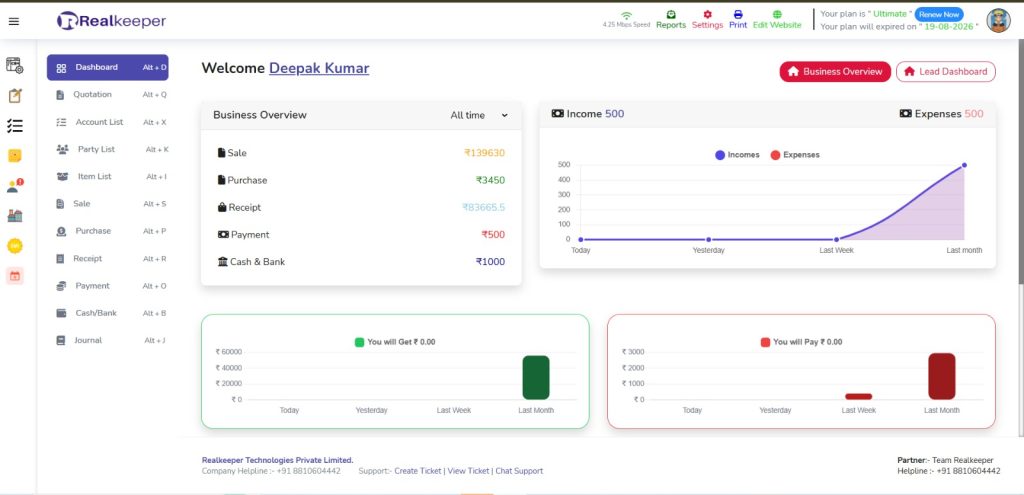
RealKeeper provides access to financial reports including Profit & Loss, Balance Sheet, Trial Balance, Cash Flow, Ledger, Day Book, GST Reports, and MIS reports.
These reports can help business owners answer practical questions:
Are we profitable?
How much cash is available?
Which customers have outstanding payments?
How much has been spent?
How is the business performing?
Instead of relying on assumptions, owners can use financial information to guide their decisions.
Accounting Software for SMEs vs Manual Accounting
| Manual Accounting | Accounting Software |
|---|---|
| Paper registers and spreadsheets | Centralized digital records |
| Repeated data entry | Integrated transaction processing |
| More manual calculations | Automated calculations |
| Difficult to track outstanding payments | Easier payment monitoring |
| Reports take considerable time | Faster financial reporting |
| Greater risk of inconsistent records | Better data consistency |
| Accounting kept separately | Accounting connected with business operations |
| Difficult to scale | Better suited for growing businesses |
Why SMEs Should Choose an Integrated ERP Instead of Only Accounting Software
This is an important distinction.
An SME may initially think it only needs accounting software. But as the business grows, accounting becomes connected with almost every other department.
Sales affects accounting.
Purchases affect accounting.
Inventory affects financial performance.
Customer payments affect cash flow.
Expenses affect profitability.
That’s why an integrated ERP can provide more value than an isolated accounting application.
RealKeeper combines GST Billing, Accounting, Inventory, Manufacturing, CRM, Sales, Purchases, Payroll, WhatsApp, and mobile access within its broader ERP offering.
Why RealKeeper Accounting ERP Software Is a Strong Choice for SMEs
RealKeeper is designed for businesses across different categories, including manufacturers, wholesalers, retailers, and service businesses.
Its integrated approach allows businesses to manage:
Accounting
Manage financial transactions and access detailed financial reports.
GST Billing
Create invoices and manage GST-related billing and reports.
Inventory
Track stock, manage warehouses, handle stock transfers, and monitor inventory movement.
Sales & Purchases
Manage the flow of goods and transactions while keeping financial records connected.
CRM
Manage leads, customers, communication, and sales-related activities.
Manufacturing
For eligible manufacturing businesses, RealKeeper provides manufacturing-focused functionality including BOM, production planning, process tracking, production costs, scrap, and subcontracting.
Financial Reports
Access important reports to understand business performance and financial position.
This makes RealKeeper more than a basic accounting application—it is an integrated business management platform.
How to Choose the Right Accounting Software for SMEs
Before choosing software, don’t simply compare the number of features.
Ask practical questions:
Does it fit my business?
Retailers, wholesalers, manufacturers, and service businesses may have different requirements.
Can accounting connect with inventory and billing?
Integration reduces duplicate work.
Are financial reports easy to understand?
Reports should help owners make decisions, not simply provide numbers.
Can the system grow with my business?
Your software should remain useful as transactions and operations increase.
Can my team use it easily?
A powerful system is only useful when employees can work with it comfortably.
The Future of SME Accounting
The role of accounting software is changing.
Businesses no longer want software that simply records what happened yesterday. They increasingly need systems that provide real-time information, automation, connected operations, and actionable business insights.
For SMEs, this shift is particularly important because technology can help a smaller team manage a growing volume of business activity.
An integrated ERP can give business owners more control without requiring them to maintain separate systems for every department.
Conclusion
For SMEs, accounting is not just a back-office responsibility. It is the foundation for understanding profitability, cash flow, expenses, customer payments, and overall business performance.
As businesses grow, manual accounting and disconnected tools can make financial management increasingly complicated.
Accounting Software for SMEs provides a smarter way to organize transactions, reduce repetitive work, improve accuracy, manage GST billing, monitor payments, and generate meaningful financial reports.
But the real advantage comes when accounting is connected with the rest of the business.
With RealKeeper ERP Accounting Software, SMEs can bring accounting, GST billing, inventory, sales, purchases, CRM, manufacturing, and financial reporting together within one integrated ecosystem.
For a growing business, the goal shouldn’t simply be to maintain accounts. It should be to understand the business better, operate more efficiently, and make every financial decision with greater confidence.