Introduction
Running a business involves much more than selling products or services. Every day, business owners and teams deal with accounting, billing, inventory, purchases, sales, customers, suppliers, payments, and reports.
When these activities are managed through separate tools, keeping everything connected can become difficult. A sales transaction may need to be entered into accounting, inventory may need to be updated separately, and payment information may have to be checked in another system.
This is where Business Management ERP Software can make a real difference.
An ERP system brings different business functions together so that important information can move between departments more efficiently. Instead of managing every operation separately, businesses can use one connected platform to organize their daily activities and gain better visibility into overall performance.
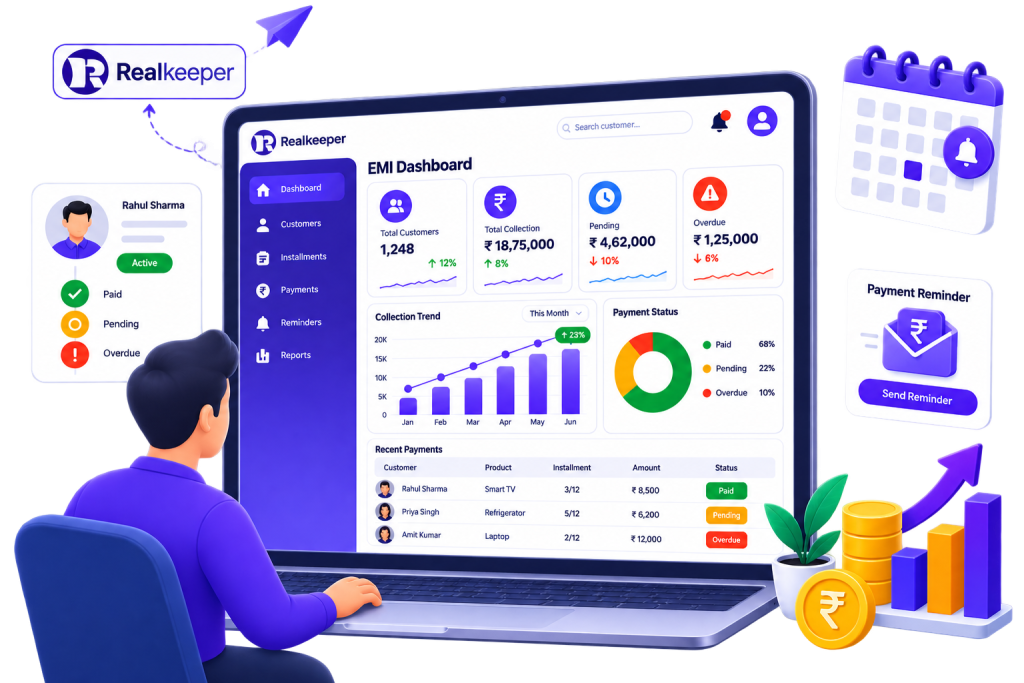
RealKeeper ERP Accounting Software is designed around this integrated approach, combining accounting with billing, inventory, sales, purchases, CRM, and business reporting.
The goal isn’t simply to put more features into one application. The real benefit is creating a connected system that helps businesses work smarter, reduce repetitive tasks, and make better decisions.
What Is Business Management ERP Software?
Business Management ERP Software is a centralized business solution that helps organizations manage multiple operational and financial activities through one system.
ERP stands for Enterprise Resource Planning. Traditionally, ERP systems were associated mainly with large organizations, but modern ERP solutions are also designed for small and medium-sized businesses.
Depending on the software, a business management ERP platform can bring together:
- Accounting
- Sales
- Purchases
- Billing
- Inventory
- Customer management
- Supplier management
- Expenses
- Payments
- Reporting
- Business performance data
The key idea is integration.
Instead of maintaining isolated records for each department, an ERP connects related activities and creates a more organized flow of information.
Why Businesses Outgrow Separate Software
Using different applications for different tasks isn’t always a problem when a business is small.
But as the business grows, so does the amount of information being generated.
Consider a simple sales transaction.
A customer places an order.
The sales team records it.
Inventory needs to be updated.
An invoice needs to be generated.
The accounting records need to reflect the transaction.
The customer’s payment needs to be tracked.
Management may later want to include that transaction in a sales report.
If every stage is handled in a different application, employees may have to enter the same information multiple times.
This creates additional work and can make it harder to maintain consistent records.
An integrated Business Management ERP Software solution connects these activities and reduces the need for disconnected workflows.
How ERP Software Connects Different Business Functions
One of the biggest strengths of Business Management ERP Software is the relationship between different modules.
For example:
Sales → Inventory → Billing → Accounting → Payment → Reporting
A purchase can similarly flow through:
Purchase → Supplier → Inventory → Accounting → Payment
This connected approach gives businesses a broader view of their operations. Instead of asking individual departments for separate information, management can access related information through the same Business Management ERP Software, helping them make faster and more informed business decisions..
7 Powerful Ways Business Management ERP Software Can Improve Operations
1. Bring Your Business Data into One Place
Business information becomes difficult to manage when it is scattered across spreadsheets, notebooks, applications, and individual computers.
Business Management ERP Software provides a centralized environment for managing important business information and keeping different operations connected.
This can help employees find relevant records more quickly and reduce the confusion created by maintaining multiple versions of the same information.
For business owners, centralized information also makes it easier to understand what is happening across different areas of the business.
2. Connect Accounting with Daily Operations
Accounting is directly affected by almost every business activity.
Sales generate revenue.
Purchases create costs.
Expenses affect profitability.
Customer payments affect receivables.
Supplier payments affect liabilities.
When accounting is separated from these activities, employees may need to transfer information manually.
With Business Management ERP Software, accounting can be connected with sales, purchases, inventory, billing, and payments.
This creates a more consistent flow of financial information and reduces repetitive data entry.
3. Improve Inventory Visibility
Inventory management becomes increasingly important as businesses handle more products and transactions.Without accurate stock information, businesses may face problems such as:
- Overstocking
- Stock shortages
- Unnecessary purchases
- Slow-moving inventory
- Difficulty identifying product demand
An integrated ERP system connects inventory with sales and purchase activities. Business Management ERP Software can bring these processes together, helping businesses maintain better control over stock and related transactions.
When a product is sold, inventory information can be updated as part of the connected workflow. Similarly, purchase records can be linked with stock management.
This gives businesses better visibility into their inventory position and helps them make more informed purchasing and sales decisions.
4. Make Billing More Efficient
Billing is an important part of the customer journey and financial process.
Manual invoice preparation can take time, particularly when businesses handle a large number of transactions.
An integrated ERP system can connect sales information with billing, reducing the need to enter the same transaction details repeatedly.
For Indian businesses, GST billing is also an important requirement. Business Management ERP Software can connect GST billing with sales and accounting, making the overall billing process more organized and efficient.
RealKeeper combines billing and accounting with other business functions, helping businesses manage invoices and related financial records in a more organized environment.
5. Strengthen Customer Management
Customer relationships don’t begin and end with a single sale.
Businesses need to understand customer history, previous purchases, interactions, outstanding amounts, and future opportunities.
When CRM and sales information are connected, employees can get a more complete view of customer relationships.
This can help businesses:
- Maintain customer records
- Track sales history
- Understand purchasing patterns
- Manage customer interactions
- Follow up more effectively
A connected CRM approach can make customer management more organized and useful for sales teams.
6. Reduce Repetitive Manual Work
Repetitive data entry is one of the most time-consuming parts of business administration.
For example, an employee may record a sale in one system and then enter the same information into another system for accounting or inventory.
Business Management ERP Software reduces this type of duplication by connecting related business modules and allowing information to flow between them more efficiently.
The result can be:
Less repetitive work → Fewer manual entries → Better consistency → More productive teams
The purpose isn’t to remove people from the process. It is to allow employees to spend less time on repetitive administrative tasks and more time on activities that require attention and decision-making.
7. Make Business Reporting Easier
Business owners need more than individual transactions. They need a clear understanding of overall performance.
Useful reports can help answer questions such as:
- How much did the business sell?
- What are the current expenses?
- Which products are performing well?
- How much inventory is available?
- Which customers have outstanding payments?
- How are purchases affecting costs?
- What is the overall financial position?
When information is already connected within an ERP system, reporting becomes more meaningful because different business activities can be viewed together.
Business Management ERP Software vs Multiple Standalone Tools
| Multiple Separate Tools | Integrated ERP Software |
|---|---|
| Information spread across applications | Centralized business information |
| Repeated data entry | Connected workflows |
| Difficult cross-department visibility | Better operational visibility |
| Separate accounting and inventory | Integrated business functions |
| Manual data transfer | Reduced duplication |
| Reports may require combining data | Centralized reporting |
| More systems to manage | One connected platform |
An ERP system isn’t automatically better for every business. The right choice depends on the company’s size, processes, budget, and requirements.
However, when a business is struggling with disconnected systems, an integrated ERP can provide significant operational advantages.
Why Integration Matters for Growing Businesses
A business may start with a few customers and products. Over time, it may have hundreds or thousands of transactions, multiple suppliers, larger inventories, more employees, and greater financial activity.
Managing this growth through disconnected tools can become increasingly difficult.
This is why Business Management ERP Software can become valuable as a company expands. By connecting accounting, sales, inventory, purchasing, and other business functions, Business Management ERP Software can help growing businesses manage their operations more efficiently.
Instead of adding another tool every time a new requirement appears, businesses can build their operations around an integrated system.
This can make processes more consistent and easier to manage.
RealKeeper: One Platform for Connected Business Management
RealKeeper is an ERP Accounting Software solution designed to bring important business functions together.
Instead of focusing only on bookkeeping, RealKeeper provides a wider business management environment covering:
Accounting
Manage financial transactions and maintain organized accounting records.
Sales
Track sales activities and customer transactions.
Purchase
Manage purchases and supplier-related records.
Inventory
Monitor stock and inventory movement.
GST Billing
Manage billing and GST-related invoicing requirements.
CRM
Organize customer information and sales-related interactions.
Reports
Access business and financial information to understand performance.
This integrated approach allows businesses to connect financial management with their everyday operations.
Who Can Benefit from Business Management ERP Software?
An integrated ERP solution can be useful for many types of businesses, including:
- Retail businesses
- Wholesale businesses
- Distributors
- Trading companies
- Manufacturing businesses
- Service businesses
- Growing SMEs
The exact requirements will differ from one industry to another.
A retailer may focus heavily on inventory and billing.
A manufacturer may require stronger connections between production, inventory, purchases, and accounting.
A service business may prioritize customer management, billing, expenses, and financial reporting.
The advantage of a flexible ERP system is that different business functions can work together according to the organization’s workflow.
What to Consider Before Choosing an ERP Solution
Choosing Business Management ERP Software is an important business decision. Don’t select a system simply because it has a long list of features. Instead, focus on whether the software can actually solve your business needs, simplify daily operations, and connect important functions effectively.
Consider these factors:
1. Business Requirements
Understand which processes need improvement before selecting the software.
2. Integration
Check whether accounting, sales, inventory, billing, purchases, and CRM can work together.
3. Ease of Use
A powerful system is only useful when employees can actually use it comfortably.
4. Reporting
Look for reports that provide practical information for business decisions.
5. Scalability
The system should be capable of supporting your business as transaction volumes and operations grow.
6. Support
Reliable customer support can be important when implementing a new business system.
The Future of Business Management
Modern businesses are becoming increasingly connected and data-driven.
Business owners want faster access to information, employees want simpler workflows, and customers expect efficient service.
This is pushing businesses away from disconnected systems toward integrated platforms.
The future of business management isn’t about collecting more data.
It’s about connecting the data you already have and turning it into useful information.
Business Management ERP Software can help create that connection between finance, sales, inventory, purchasing, customers, and management, giving businesses a more organized view of their overall operations.
Conclusion
Managing a growing business requires more than keeping separate records for accounting, sales, inventory, purchases, and customers.
These functions are connected, and the software used to manage them should ideally reflect those connections.
Business Management ERP Software can help organizations centralize information, connect daily operations, reduce repetitive work, improve reporting, and gain better control over business activities.
With RealKeeper ERP Accounting Software, businesses can manage accounting, GST billing, sales, purchases, inventory, CRM, and reporting through an integrated platform.
The real advantage of ERP isn’t simply having everything in one place.
It’s having connected business operations that help your team work efficiently, your management understand performance, and your business grow with greater control.