
Introduction
In today’s competitive business environment, inventory is one of the most valuable assets of any organization. Whether you’re managing a retail store, wholesale business, manufacturing unit, or distribution company, maintaining accurate inventory is essential for smooth operations and customer satisfaction. However, managing inventory manually or through multiple disconnected systems often leads to stock inaccuracies, delayed deliveries, excess inventory, and unnecessary operational costs.
This is where Inventory Management ERP becomes an essential business solution.
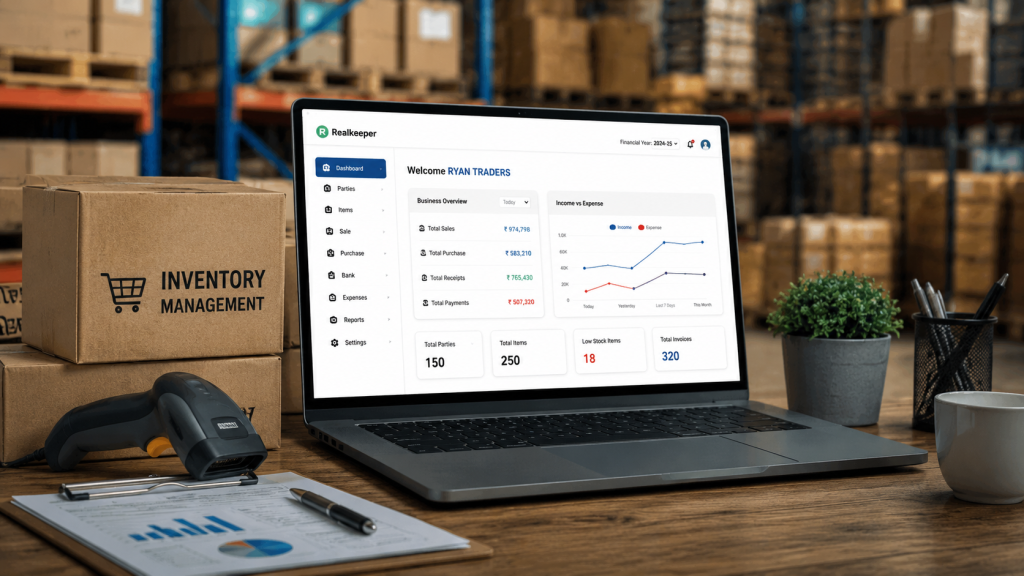
An Inventory Management ERP system integrates inventory management with accounting, billing, purchasing, sales, GST compliance, and financial reporting into one centralized platform. Instead of maintaining separate records for different departments, businesses can monitor every inventory movement in real time from a single dashboard.
RealKeeper Accounting ERP Software is designed to simplify inventory management while improving business efficiency through automation, real-time reporting, and intelligent business insights. By eliminating manual processes and connecting all business operations, RealKeeper helps organizations reduce errors, improve productivity, and make smarter business decisions.
In this comprehensive guide, we’ll explore how Inventory Management ERP transforms inventory control, improves operational efficiency, and supports sustainable business growth.
What is Inventory Management ERP?
Inventory Management ERP is an integrated business management system that helps businesses monitor, control, and optimize inventory while connecting it with accounting, billing, purchasing, sales, GST, and financial management.
Unlike traditional inventory systems that only record stock movements, an ERP solution automatically updates inventory whenever purchases, sales, returns, or stock transfers occur.
For example, when a sales invoice is generated:
- Inventory is reduced automatically.
- Accounting entries are recorded instantly.
- GST calculations are applied automatically.
- Financial reports are updated in real time.
This automation eliminates duplicate data entry while ensuring every department works with accurate business information.
Why Businesses Need Inventory Management ERP
As businesses expand, inventory management becomes increasingly complex.
Without a centralized inventory system, companies often face challenges such as:
- Stock shortages
- Overstocking
- Manual inventory errors
- Delayed order processing
- Inaccurate stock records
- Poor warehouse visibility
- Slow inventory reporting
- Increased operational costs
These challenges directly affect customer satisfaction, cash flow, and overall profitability.
Inventory Management ERP solves these problems by automating inventory processes and providing complete visibility into stock movements.
Businesses gain better inventory control, faster operations, and more accurate decision-making.
Key Benefits of Inventory Management ERP
1. Real-Time Inventory Tracking
One of the biggest advantages of Inventory Management ERP is real-time stock visibility.
Every purchase, sale, stock transfer, or return automatically updates inventory records.
Business owners always know:
- Current stock availability
- Product movement
- Warehouse inventory
- Available quantities
- Reserved stock
Real-time tracking eliminates guesswork and improves inventory accuracy.
2. Reduces Manual Errors
Manual inventory management often creates problems such as:
- Incorrect stock entries
- Duplicate records
- Missing inventory
- Calculation mistakes
Inventory Management ERP automates stock updates and minimizes human intervention.
This significantly improves inventory accuracy while reducing costly business errors.
3. Faster Billing with Automatic Inventory Updates
Billing and inventory work together in every business.
With RealKeeper Accounting ERP Software, every invoice generated automatically updates inventory levels.
This means businesses no longer need to update stock manually after each sale.
Benefits include:
- Faster billing
- Accurate stock records
- Improved customer service
- Better inventory synchronization
4. Better Warehouse Management
Businesses with multiple storage locations often struggle to monitor inventory effectively.
Inventory Management ERP provides better warehouse control by allowing businesses to:
- Monitor warehouse-wise inventory
- Track product movement
- Manage stock transfers
- Improve storage efficiency
This reduces inventory confusion while improving operational efficiency.
5. Low Stock Alerts
Running out of inventory can result in lost sales and unhappy customers.
Inventory Management ERP automatically notifies businesses when products reach minimum stock levels.
Low stock alerts help businesses:
- Reorder products on time
- Avoid stock shortages
- Improve purchasing decisions
- Maintain continuous business operations
6. Smart Purchase Management
Effective inventory management starts with smart purchasing. Buying too much inventory increases storage costs, while buying too little can lead to stock shortages and missed sales opportunities.
An Inventory Management ERP system helps businesses maintain the right stock levels by analyzing inventory movement and purchase history.
With RealKeeper Accounting ERP Software, businesses can:
- Monitor purchase orders in real time
- Track supplier transactions
- Maintain accurate purchase records
- Plan inventory replenishment efficiently
- Reduce unnecessary purchasing costs
This ensures businesses always have the right products available without overinvesting in inventory.
7. Complete Integration with Accounting
Inventory management is closely connected with accounting. Every purchase, sale, return, or stock adjustment directly affects business finances.
Instead of recording these transactions manually, Inventory Management ERP automatically updates accounting records whenever inventory changes occur.
With RealKeeper Accounting ERP Software, businesses benefit from:
- Automatic accounting entries
- Updated inventory valuation
- Real-time financial records
- Accurate profit calculations
- Better cash flow monitoring
This integration eliminates duplicate work while improving financial accuracy and operational efficiency.
8. Real-Time Business Reports
Business owners need reliable information to make better decisions.
Inventory Management ERP provides detailed reports that help businesses monitor inventory performance and financial health.
Important reports include:
- Stock Summary Reports
- Product Movement Reports
- Fast-Moving Products
- Slow-Moving Inventory
- Purchase Reports
- Sales Reports
- Inventory Valuation Reports
- Profit & Loss Reports
- Cash Flow Reports
These reports provide complete visibility into business operations, helping owners identify opportunities, control costs, and improve profitability.
9. Improved Business Productivity
Managing inventory manually requires significant time and effort. Employees often spend hours updating stock records, preparing reports, and correcting inventory errors.
Inventory Management ERP automates these repetitive tasks, allowing teams to focus on more valuable activities such as customer service, sales growth, and business expansion.
Automation improves:
- Employee productivity
- Order processing speed
- Inventory accuracy
- Workflow efficiency
- Customer satisfaction
As a result, businesses can operate faster while delivering a better customer experience.
10. Supports Long-Term Business Growth
As businesses grow, inventory becomes more difficult to manage. Increased product lines, multiple warehouses, and higher transaction volumes require a scalable management system.
Inventory Management ERP is designed to grow alongside your business.
RealKeeper supports expansion by offering:
- Multi-user access
- Scalable inventory management
- Centralized data
- Secure business records
- Faster reporting
- Better operational control
Whether you’re expanding to new locations or handling larger inventories, an ERP system ensures your business remains organized and efficient.
Inventory Management ERP vs Manual Inventory Management
| Manual Inventory Management | Inventory Management ERP |
|---|---|
| Manual stock updates | Automatic inventory updates |
| Higher chances of errors | Improved inventory accuracy |
| Separate accounting records | Integrated accounting and inventory |
| Delayed inventory reports | Real-time inventory reporting |
| Difficult warehouse management | Centralized warehouse control |
| Manual purchase tracking | Automated purchase management |
| Slow billing process | Instant billing with stock updates |
| Limited business visibility | Complete operational visibility |
This comparison clearly shows how Inventory Management ERP transforms inventory control by replacing manual processes with intelligent automation. Businesses gain greater accuracy, faster workflows, better financial control, and complete visibility over stock movements, enabling them to make smarter decisions and improve overall operational efficiency.
Why Choose RealKeeper Accounting ERP Software?
RealKeeper Accounting ERP Software provides a complete Inventory Management ERP solution that helps businesses manage inventory, accounting, billing, GST, purchases, sales, and financial reporting from one centralized platform.
Instead of relying on multiple software applications, RealKeeper connects every business function into a single intelligent system that improves productivity, reduces manual work, and enhances decision-making.
Key Features of RealKeeper
- Real-Time Inventory Tracking
- Smart Billing & Invoicing
- Accounting Management
- Purchase Management
- Sales Management
- GST Compliance
- Warehouse Management
- Stock Valuation Reports
- Financial Reporting
- Expense Tracking
- Business Analytics
- Multi-User Access
- Secure Data Management
- Dashboard & Performance Reports
With these integrated features, businesses can simplify operations, improve inventory accuracy, reduce operational costs, and achieve sustainable business growth.
Best Practices for Effective Inventory Management
To maximize the benefits of Inventory Management ERP, businesses should follow these best practices:
- Update inventory regularly through automated processes.
- Monitor stock levels in real time.
- Review inventory reports frequently.
- Set minimum stock alerts for critical products.
- Maintain accurate purchase and sales records.
- Train employees to use ERP features effectively.
- Analyze fast-moving and slow-moving inventory.
- Use real-time dashboards to monitor business performance.
Following these practices helps businesses improve efficiency, reduce waste, and maintain complete inventory control.
Future of Inventory Management ERP
As businesses continue to adopt digital technologies, Inventory Management ERP is becoming an essential part of modern business management. Automation, cloud technology, real-time analytics, and integrated financial management are helping businesses operate more efficiently than ever before.
Future-ready businesses need systems that provide accurate inventory tracking, instant reporting, and seamless integration between inventory, accounting, billing, and financial management.
Investing in a modern ERP solution today prepares businesses for future growth, improves operational flexibility, and strengthens overall business performance.
Conclusion
Efficient inventory management is the foundation of a successful business. Manual inventory processes often lead to stock inaccuracies, operational delays, and higher costs, making it difficult for businesses to grow efficiently.
Inventory Management ERP provides a smart and centralized solution by integrating inventory, accounting, billing, GST, purchasing, sales, and financial reporting into one platform.
With RealKeeper Accounting ERP Software, businesses can automate inventory management, improve stock accuracy, simplify financial operations, reduce manual errors, and gain real-time business insights. By streamlining everyday processes and providing complete operational visibility, RealKeeper empowers businesses to make faster decisions, enhance productivity, and achieve long-term growth.
As digital transformation continues to reshape industries, implementing Inventory Management ERP is no longer just an option—it is a strategic investment for businesses that want to stay competitive, efficient, and future-ready.