
If your factory still runs on spreadsheets and WhatsApp messages, you already know the problem. Someone forgets to update stock, an order ships short, and you’re the one explaining it to the customer. Manufacturing software fixes exactly this kind of gap — it tracks raw materials, production stages, and billing in one place, so growth doesn’t mean more chaos. Here are seven ways it actually changes day-to-day operations for a small or mid-size manufacturer.
1. How Does Manufacturing Software Reduce Production Errors?
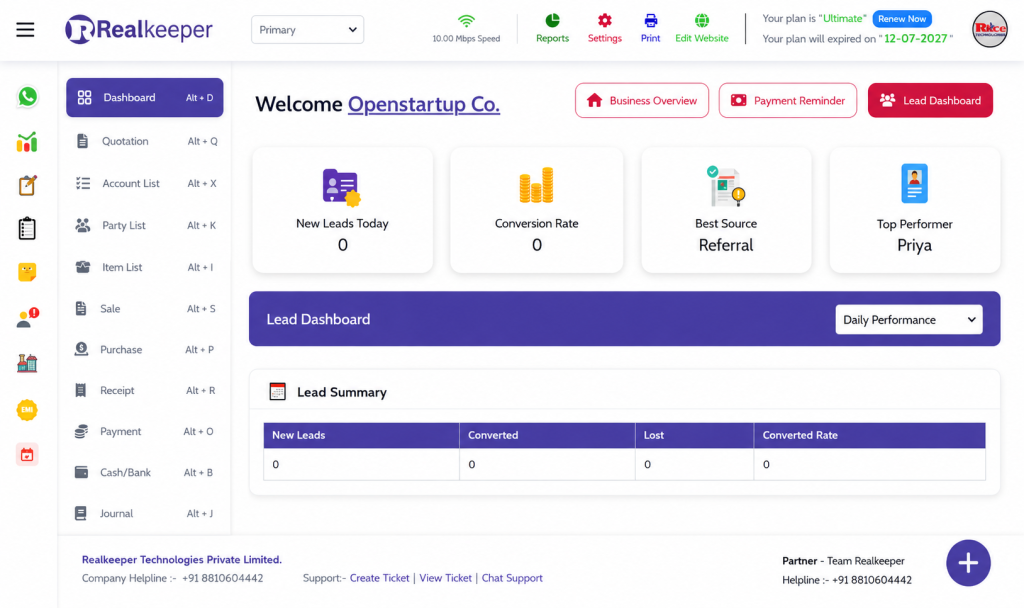
Building a Bill of Materials by hand invites mistakes: a missed component, an outdated quantity, a version nobody remembers updating. Manufacturing software generates a BOM in a single click and keeps it tied to your live inventory, so the numbers on paper match what’s actually on the shelf. RealKeeper builds this directly into its manufacturing ERP module. For a plywood, hardware, or parts business juggling dozens of SKUs, that one change removes a lot of guesswork. You stop reordering material you already have, and you stop discovering shortages halfway through a production run. Over a full year, that alone can save several days of production downtime that would otherwise go toward chasing missing parts.
2. Does Manufacturing Software Handle GST Billing Automatically?
Tax rules don’t wait for your business to catch up. Manufacturing software with built-in GST billing generates e-way bills and e-invoices automatically, applies the correct tax slabs, and keeps your records audit-ready without extra effort. RealKeeper’s billing module works alongside production data, so your invoices reflect what you actually manufactured and shipped, not a figure typed in separately by someone in accounts later. Fewer manual entries usually means fewer notices from the tax department down the line. It also makes filing season shorter, since profit and loss, ledger, and GST reports pull from the same records instead of three different spreadsheets that need reconciling first.
3. Can Manufacturing Software Show Real-Time Stock Levels?
Ask any small manufacturer what keeps them up at night, and stockouts sit near the top of the list. Real-time inventory tracking shows exactly what raw material you have, what’s already committed to open orders, and what needs reordering, updated the moment a transaction happens rather than at month-end. This visibility works across devices, too. You can check stock from your phone during a supplier meeting instead of waiting until you’re back at the desktop in your office. It also cuts down on the awkward calls to a supplier asking for an emergency delivery because nobody noticed the raw material was already running low three days earlier.
4. How Does Manufacturing Software Speed Up Production Planning?
Growing businesses take on custom orders, and custom orders are where manual planning tends to fall apart first. Made-to-order workflows let you plan a job against actual material availability and existing work orders before you commit to a delivery date. RealKeeper also tracks purchase requisitions, or indents, so procurement starts the moment a shortfall shows up — not a week later, when someone finally gets around to checking the shelf.
5. Can Manufacturing Software Calculate the Real Cost of a Job?
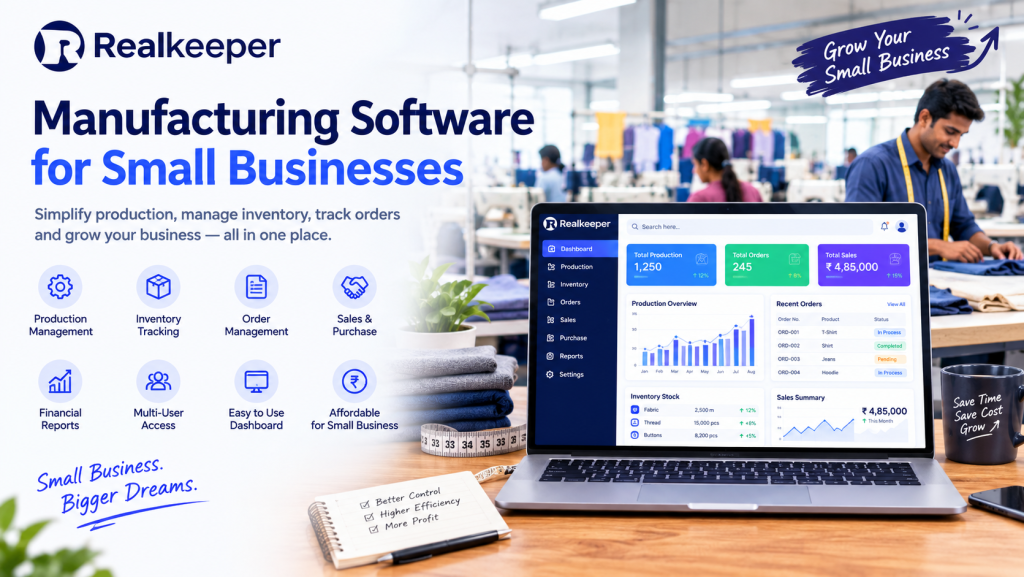
Most small manufacturers price jobs on rough estimates, mainly because calculating real costs by hand takes too long to bother with every time. Software that tracks production cost, scrap, and subcontracting activity gives you the actual number instead of a guess. If a job is losing money because of high wastage or an expensive subcontractor, you’ll see it in the data — not months later, when your accountant flags a thinner-than-expected margin at year-end. That’s the difference between quoting your next customer based on what a job should cost and quoting based on what it actually did cost last time.
6. Does Manufacturing Software Work With CRM and WhatsApp?
Production and sales usually live in separate worlds. One team tracks orders, another tracks customers, and nobody talks to each other in real time. Combining manufacturing ERP with CRM and WhatsApp integration changes that: a sales lead, an order status, and a payment reminder all sit in one system. RealKeeper sends WhatsApp updates directly from the platform, so a customer asking “where’s my order” gets an answer in minutes rather than after three phone calls back and forth. Payment collection follows the same logic — reminders go out automatically instead of depending on someone remembering to call every overdue account.
7. Can You Manage Your Factory From Your Phone?
A factory owner shouldn’t need to be physically present just to approve a purchase order or check today’s production numbers. Cloud-based manufacturing software runs on desktop, tablet, and mobile, so you can review reports — profit and loss, stock ledgers, GST filings — from wherever you happen to be. That access alone often justifies switching, especially for owners who spend half their week visiting suppliers or client sites instead of sitting at a desk. It also matters for growing teams: a second location or a new supervisor doesn’t need a new system, just a login.
How Is Manufacturing Software Different From Manual Spreadsheets?
Here’s a plain comparison of what changes once production and billing move off spreadsheets and into one system:
| Task | Manual / Spreadsheets | Manufacturing Software (RealKeeper) |
| Creating a Bill of Materials | Hours of manual entry, easy to get wrong | Generated in one click, linked to live stock |
| GST billing | Typed in separately, error-prone | Auto e-invoice and e-way bill from production data |
| Stock visibility | Updated end of day or week | Real-time, viewable from any device |
| Cost tracking | Rough estimate per job | Actual cost including scrap and subcontracting |
| Customer updates | Phone calls, delayed replies | Automated WhatsApp status alerts |
Which RealKeeper Plan Should a Growing Manufacturer Choose?
RealKeeper sells three plans, and the difference between them comes down to how much of the business you want to run on the platform — not just billing volume:
| Feature | Basic (₹5,000/yr + 18% GST) | Advance (₹9,000/yr + 18% GST) | Ultimate (₹18,000/yr + 18% GST) |
| Users | 2 users | 2 users | 5 users |
| General billing | Yes | Yes | Yes |
| WhatsApp CRM | No | Yes | Yes |
| E-commerce website | No | No | Yes |
| MSME manufacturing (BOM, production) | No | No | Yes |
| Domain | Subdomain | Custom domain | Custom domain |
| Platforms | Android + Web/Desktop | Android + Web/Desktop | Android + Web/Desktop |
Our Take
If you only need GST billing, Basic is enough. But if you’re a manufacturer specifically, the Ultimate plan is the one that matters — it’s the only tier that includes MSME Manufacturing (BOM, production tracking, and subcontracting), alongside WhatsApp CRM and e-commerce. Paying for the Basic or Advance plan and trying to manage manufacturing on a separate spreadsheet defeats the purpose.
Frequently Asked Questions
What does manufacturing software actually do for a small business?
It replaces manual spreadsheets and registers with one system that tracks raw materials, production stages, billing, and reporting together, so you always know your real stock levels and true production cost.
Is manufacturing software only for large factories?
No. Tools built for MSMEs, such as RealKeeper’s manufacturing ERP, are priced and designed for small teams, with plans starting at 2 users.
Does manufacturing software handle GST compliance automatically?
Yes. It generates GST-compliant invoices, e-way bills, and e-invoices directly from your sales and production data, which cuts down manual tax entry and reduces errors.
How long does it take to set up manufacturing software?
Basic billing can go live within minutes. RealKeeper advertises go-live in 5 minutes for general billing, with free training included to get the manufacturing module running.
What does manufacturing software cost in India?
Pricing depends on features. RealKeeper’s plans start at ₹5,000 per year for basic billing and go up to ₹18,000 per year for the Ultimate plan, which adds MSME manufacturing, WhatsApp CRM, and e-commerce, plus 18% GST.
Can I try manufacturing software before buying it?
Most vendors offer a trial period. RealKeeper gives a free 7-day trial with no credit card required, so you can test the manufacturing and billing modules on your own data before committing.
So, Should You Switch to Manufacturing Software?
Manufacturing software isn’t about chasing technology for its own sake. It’s about removing the daily friction that slows a growing business down — wrong stock counts, late invoices, and cost estimates nobody fully trusts. None of these seven benefits require an IT team or a long rollout; most small manufacturers are running GST billing within the same day and adding the manufacturing module once the team is comfortable. If your production has outgrown your spreadsheet, start with a free trial and see how much manual work it actually replaces.
RealKeeper Technologies, based in Delhi, offers a 7-day free trial with no credit card required for businesses ready to make that move, along with free onboarding training and chat support that responds within about 30 seconds. Explore the plans at realkeeper. in.