If you’re comparing HRMS software in India, you’ve likely hit the same wall everyone does: every vendor says it’s the best, and most “top 10” lists are published by a vendor. This guide takes a different route. It explains what an HRMS has to do in an Indian company, what it really costs, how the new Labour Codes and data-protection rules change the decision, and which type of platform fits which type of business.
Full disclosure: we build Realkeeper, a Delhi-based cloud ERP and CRM with HR and attendance modules, so we’ve included it in the comparison and said plainly where a dedicated HRMS is the better fit.
What is HRMS software, and what does it do?
HRMS (Human Resource Management System) software is a cloud platform that runs the core HR workflow in one place: employee records, attendance, leave, payroll, statutory compliance, onboarding, performance and exit. In India, the payroll and compliance engine is the part that decides whether the tool is any good, because PF, ESI, professional tax, labour welfare fund and TDS rules vary by state and keep changing.
A typical Indian HRMS, including Realkeeper’s HR & attendance software, covers these modules:
- Core HR: employee database, documents, org chart, letters
- Attendance and leave: biometric, GPS or selfie check-ins, shifts, overtime, holiday calendars
- Payroll and compliance: salary processing, payslips, PF/ESI/PT/LWF/TDS filings, Form 16
- Employee self-service (ESS): mobile app for leave, payslips, reimbursements, declarations
- Talent modules: recruitment (ATS), onboarding, goals and appraisals, engagement
- Analytics: headcount, attrition, payroll cost, compliance dashboards
What are the benefits of HRMS software for Indian businesses?
The biggest benefit is fewer payroll and compliance errors, because attendance, leave and salary data flow through one system instead of three spreadsheets. That one change creates most of the other gains.
- Accurate payroll: attendance and leave feed salary directly, so no month-end re-keying and fewer disputes
- Audit-ready records: contribution histories, payslips and filings sit in one place when an inspector or auditor asks
- Time back for HR: routine requests (leave, payslips, letters) move to employee self-service
- Control across locations: one policy engine for offices, plants and field teams
- Better decisions: attrition, absenteeism and payroll cost are visible without a manual report
None of this requires a large HR team. In fact, small companies with one HR person and an external CA often gain the most, because the system replaces work that currently depends on one person’s memory.
Why is demand for HRMS software in India rising in 2026?
Three things are pushing Indian companies off spreadsheets at the same time: a rewrite of labour law, a new data-protection regime, and a market of vendors cheap enough for a 20-person company to afford.
The four Labour Codes changed payroll rules
On 21 November 2025, the government announced that four labour codes were in force, merging 29 central labour laws into the Code on Wages, the Industrial Relations Code, the Code on Social Security and the Occupational Safety, Health and Working Conditions Code. The part that hits HR first is the standardised definition of “wages”, because PF, gratuity and bonus are calculated on it.
Under the Code on Wages, basic pay, dearness allowance and retaining allowance generally need to make up at least half of total remuneration. A company running a low-basic, high-allowance CTC will see statutory costs rise, and startups and SMEs are among the most exposed. Central and state rules are still being notified, so the practical details keep moving. Treat this as a direction, and confirm your own salary structure with a CA or labour-law consultant.
What this means for software: you want a payroll engine with configurable salary components and a vendor that ships rule updates, not one that hard-codes today’s formulas.
The DPDP Rules put employee data under a legal microscope
The Digital Personal Data Protection Rules, 2025 were notified on 13 November 2025 with three commencement dates: 14 November 2025, 14 November 2026 and 14 May 2027. The core employer obligations fall in the last phase, so May 2027 is your real deadline. Employers act as data fiduciaries for employee data. That brings duties around privacy notices, security safeguards, retention and erasure, and breach reporting: an initial intimation without delay, then a detailed report to the Data Protection Board within 72 hours.
Processing data for payroll and other employment purposes doesn’t need separate consent, but the notice and security duties still apply. Biometric attendance deserves a second look in particular. For a plain-English summary of the Rules, see SCC Online’s key highlights. Check for amendments before you act, since the transition timeline has been debated.
The market is growing, and the vendors are competing on price
TechSci Research values the India HRMS market at about USD 870 million in 2025, growing to roughly USD 2.27 billion by 2031 (a 17.34% CAGR). Other research firms use different scopes and report different numbers, so read these as a sign of direction, not precision. The practical effect is easy to see: entry-level plans now start at a few thousand rupees a month, and some vendors offer free tiers for very small teams.
Which features should HRMS software in India include?
The non-negotiables for an Indian business are state-wise statutory payroll, flexible salary structures, mobile attendance that fits your workforce, and data-security controls. Everything else is secondary until those four pass your test.
| Feature | What to check | Why it matters in India |
| Statutory payroll | PF, ESI, professional tax and LWF for every state you operate in; TDS, Form 16, ECR files | Rates and slabs differ by state; one missed filing means penalties |
| Labour Code readiness | Configurable salary components; how and when the vendor ships rule updates | The wage definition changes PF, gratuity and bonus bases |
| Attendance | Biometric, GPS, selfie, geo-fencing, shift and overtime rules | Field teams, factories and multi-location offices track time differently |
| Leave and holidays | State-wise holiday calendars, comp-off, custom leave policies | Holiday lists are not uniform across states |
| Mobile self-service | Android and iOS app for leave, payslips, declarations | Many employees only ever use their phone |
| Onboarding | Digital documents, e-signature, offer-to-joining workflow | Cuts paperwork for bulk or frequent hiring |
| Performance | Goals/OKRs, review cycles, feedback | Matters most for mid-size and tech-led teams |
| Security and DPDP controls | Role-based access, audit logs, retention and erasure tools, breach process, data-hosting location | Employee data is now a regulated asset |
| Integrations | Accounting tools such as Tally, biometric devices, bank payout | Payroll fails when it can’t hand data to finance |
For filings, the official portals are EPFO for provident fund and ESIC for employee insurance. Whatever HRMS you pick should produce data these portals accept. A system like Realkeeper’s payroll and HR management software ties salary processing to attendance and leave records, which removes the month-end re-keying that causes most errors.
Cloud or on-premise: which HRMS deployment suits Indian companies?
For most Indian companies, a cloud HRMS is the practical choice: lower upfront cost, automatic updates and access from any device. The updates matter more than they used to, since statutory rules and Labour Code notifications keep changing.
On-premise or private-hosted setups still make sense for a few buyers, such as organisations with strict internal data policies or heavy customisation needs. If you fall in that group, ask the vendor who patches the system, who pays for compliance changes, and how backups and breach response work. Cheap hosting that nobody maintains becomes a DPDP problem.
Are AI features in HRMS software worth paying for?
Several vendors now lead with AI: CV parsing, HR chatbots, attrition prediction and automated document checks. Some are useful. A chatbot that answers leave-balance questions saves HR real time, and CV parsing helps teams that hire in volume. Predictive analytics is a different story. It needs clean data and a few years of history before it says anything reliable.
Our recommendation: don’t pay a premium for AI until payroll, attendance and compliance work flawlessly. Treat AI as a tiebreaker between two otherwise equal products, and ask each vendor to show it working on your own data, not a demo tenant.
How much does HRMS software cost in India?
Most Indian vendors charge either per employee per month or a monthly plan for a band of employees. For a team of 50, published entry prices cluster roughly between ₹2,500 and ₹7,000 a month; enterprise platforms quote on request. Free tiers exist for very small teams.
| Vendor | Published starting price (verify) | Typically positioned for |
| greytHR | About ₹2,495 to ₹4,495/month at 50 employees (sources differ); one list notes a free tier below 25 employees | Compliance-first small and mid-size firms |
| factoHR | ₹4,999/month up to 50 employees | Growing and multi-state firms, manufacturing |
| Keka | From about ₹6,999/month (about 100 employees on one list) | Mid-size, tech-led companies |
| Zoho People | Roughly ₹48 to ₹60 per employee/month on entry plans | Teams already on Zoho |
| Pocket HRMS | ₹2,995/month for 50 employees; ₹60 per employee/month on another list | Cost-sensitive SMEs |
| RazorpayX Payroll | About ₹100 per user/month | Startups focused on payroll |
| Realkeeper | ERP plans from ₹5,000 + 18% GST (2 users, billing); payroll is included in the ₹40,000 + 18% plan (10 users), with lower renewal pricing. See Realkeeper pricing | MSMEs wanting HR inside a business-wide ERP |
| Kredily | Free plan for payroll and attendance (check limits) | Very small teams and startups |
| Darwinbox, ZingHR, PeopleStrong | Custom quote | Large enterprises, frontline workforces |
These figures come from vendor and comparison pages (many written by vendors themselves) and change often. Treat them as a range for budgeting and get written quotes before you decide.
The sticker price is rarely the full price. Ask about:
- Implementation and data-migration fees
- Payroll or compliance modules sold as add-ons
- Biometric or face-recognition hardware
- Per-module pricing for performance, ATS or engagement
- Support tiers and response times
- GST on top of the quoted rate, and annual price escalation
Which HRMS software in India fits your company?
There’s no single best HRMS in India. The right one depends on headcount, number of states, workforce type and the ecosystem you already use. The names below recur across several 2026 comparisons. It’s a shortlist to test, not a ranking, and we haven’t benchmarked these products ourselves.
| Company profile | Names worth shortlisting | What to test first |
| Startups and small teams (under 50) | greytHR, Zoho People, Kredily, RazorpayX Payroll, Pocket HRMS | Payroll accuracy and how fast you can go live |
| Growing SMEs (50 to 500) | Keka, factoHR, HROne, Zimyo | Mobile experience, performance module, Labour Code updates |
| Manufacturing and multi-shift | factoHR, Savvy HRMS, greytHR | Shift and overtime rules, contract labour, multi-state compliance |
| Small manufacturers, traders, service firms wanting HR inside ERP | Realkeeper (HR & attendance with cloud ERP and CRM) | Whether payroll depth covers your states |
| Already on Zoho | Zoho People with Zoho Payroll | Whether payroll depth matches your states |
| Large enterprises (1,000+) | Darwinbox, ZingHR, PeopleStrong; SAP SuccessFactors or Workday for global groups | Multi-entity setup, analytics, integration effort |
| Bulk and frontline hiring | PeopleStrong | Onboarding speed, shift management at scale |
| Hiring or paying talent abroad | Deel alongside an Indian HRMS | EOR and contractor payments across countries |
Our view: small teams shouldn’t buy enterprise suites. A 40-person company doesn’t need a 60-module platform and a three-month rollout. If payroll compliance is your main pain, start with a compliance-led tool. If you need a modern day-to-day experience for a growing team, test the mid-market products. Enterprises should insist on a paid pilot before signing, not a polished demo.
How does Realkeeper compare with other HRMS software in India?
Realkeeper is a cloud ERP and CRM for Indian MSMEs with an HR and attendance module, so it fits best where HR is one part of a bigger business system. A dedicated HRMS such as greytHR, factoHR or Keka goes deeper on statutory payroll and talent features.
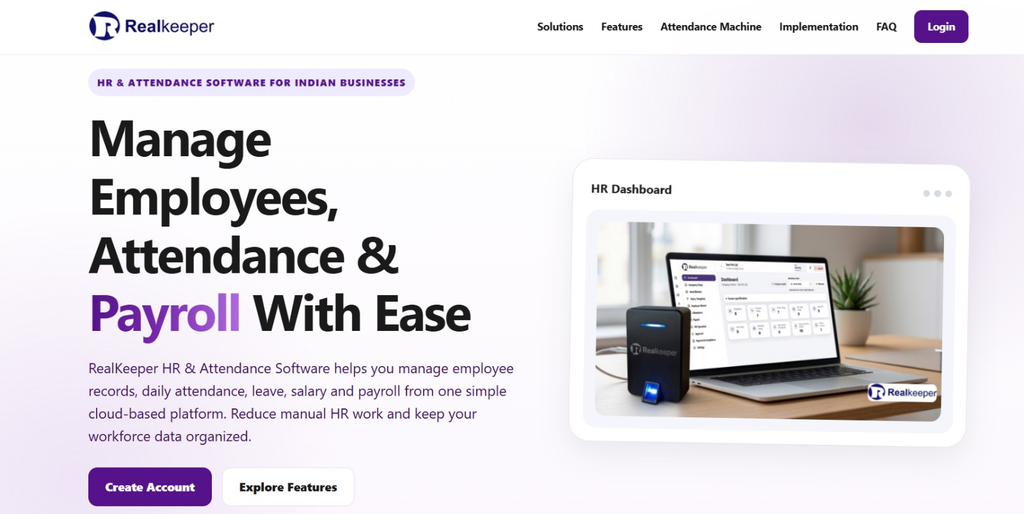
Realkeeper’s HR & attendance software covers employee profiles, punch in and out, late and early tracking, leave, salary structures, payroll, payslips and reports. It runs on the same platform as accounting, inventory, CRM and manufacturing ERP, and the company also offers a biometric attendance machine.
| Factor | Realkeeper | Dedicated HRMS (greytHR, factoHR, Keka) | Enterprise HCM (Darwinbox, ZingHR) |
| Product type | Cloud ERP and CRM with HR and payroll module | Standalone HR, payroll and compliance suite | Large-scale HR and talent platform |
| Best fit | MSMEs, manufacturers, traders, service firms | SMEs to mid-size, HR-led buyers | 1,000+ employee organisations |
| Attendance and leave | Punch in/out, late and early tracking, leave records, reports | Yes, usually with wider shift and policy options | Yes, multi-entity |
| Payroll | Salary structures, monthly payroll, payslips | Deep statutory engines are a core selling point | Configurable at scale |
| PF, ESI, PT, LWF filings | [Add your supported statutory filings here] | Typically a headline feature; verify by state | Typically a headline feature |
| Accounting, inventory, CRM | Built into the same platform | Usually integrated with other tools such as Tally | Integrations |
| Attendance hardware | Biometric attendance machine offered | Biometric integrations are common | Varies |
| Labour Code and DPDP controls | [Add your update process and data controls here] | Ask each vendor for specifics | Ask each vendor for specifics |
| Pricing model | Published ERP bundles; see pricing and compare plans | Per-employee or per-band plans | Custom quote |
Choose Realkeeper if you want billing, inventory or manufacturing, CRM and HR under one login and one vendor, you want attendance data to flow straight into payroll, and your HR needs are practical rather than elaborate. For a side-by-side with accounting tools, see Realkeeper vs TallyPrime, Busy, Vyapar and Zoho Books.
Choose a dedicated HRMS if you run complex multi-state payroll, need performance, recruitment or engagement modules, or HR (not finance or operations) leads the purchase. Honest advice: if HR is your only need, don’t buy an ERP for it.
How do you choose HRMS software in India? Seven checks before you sign
- Run your real payroll in parallel for one cycle. Compare the vendor’s output with your current numbers to the rupee. A demo using sample data proves nothing.
- Test every state you operate in. Ask for professional tax and LWF handling in each one, not “all states supported” on a slide.
- Ask how Labour Code changes are delivered. Who updates the formulas, how fast, and at what cost? Get the answer in writing.
- Match attendance to your workforce. Office staff, field teams and factory shifts need different tools. Test the one you actually have.
- Ask the DPDP questions. Where is data hosted, who can see it, are access logs kept, can you set retention and erasure rules, and what’s the breach-notification process?
- Calculate three-year cost. Include implementation, add-ons, hardware, GST and renewal increases.
- Call two references of your size and industry. A 5,000-person enterprise reference tells a 60-person company very little.
How does HRMS implementation work, and how long does it take?
Implementation usually runs in five stages: data cleanup, configuration, payroll parallel run, training and go-live. Timelines depend on headcount, number of states and how messy your records are, so ask the vendor for a written plan with named milestones instead of a verbal estimate.
- Clean your data first. Fix PAN, UAN, bank details and joining dates before migration. This step slows more projects than any software limitation.
- Configure policies. Leave rules, shifts, salary structures, approval chains and state-wise statutory settings.
- Run a parallel payroll. Process one cycle in the old and new systems and reconcile every difference.
- Train HR and employees. A short session on the mobile app prevents a flood of questions in week one.
- Go live in a quiet month. Avoid starting right before appraisals, bonus payouts or the financial year-end.
What mistakes do companies make when buying HRMS software?
- Buying for the demo, not the payroll run. Slick dashboards are easy. Accurate multi-state payroll is hard. Test the hard part.
- Ignoring data quality. Messy employee records migrate as messy records. Clean the data before go-live, not after.
- Treating compliance as the vendor’s problem alone. The software helps; the employer remains responsible for filings and records.
- Over-buying modules. Start with core HR, attendance and payroll. Add performance and engagement when you’ll actually use them.
Frequently asked questions about HRMS software in India
What is the best HRMS software in India?
There is no single best HRMS software in India. Small teams commonly shortlist greytHR, Zoho People or Kredily, growing companies look at Keka, factoHR or HROne, and large enterprises evaluate Darwinbox, ZingHR or PeopleStrong. The right choice depends on headcount, number of states, workforce type and budget.
How much does HRMS software cost in India?
For about 50 employees, published entry prices for Indian HRMS software range from roughly ₹2,500 to ₹7,000 per month, and some vendors offer free plans for very small teams. Enterprise platforms price on request. GST, implementation, hardware and add-on modules are usually extra.
Is HRMS software mandatory in India?
No law requires a company to use HRMS software. However, employers must maintain statutory records and file PF, ESI, professional tax and TDS returns, and an HRMS makes that practical and auditable as headcount grows.
Which HRMS is best for small businesses in India?
Small businesses should prioritise accurate statutory payroll, simple attendance and low setup effort. Commonly shortlisted options include greytHR, Zoho People, Pocket HRMS, RazorpayX Payroll and Kredily. Businesses that also need billing, inventory and CRM can consider an ERP with an HR module, such as Realkeeper. Test each option on your own payroll before paying.
Do the new Labour Codes affect which HRMS I should choose?
Yes. The four Labour Codes, in force since 21 November 2025, standardise the definition of wages, which affects PF, gratuity and bonus calculations. Choose an HRMS with configurable salary structures and a vendor that commits to timely compliance updates.
Does the DPDP Act apply to employee data in an HRMS?
Yes. Under the Digital Personal Data Protection Act, 2023 and the DPDP Rules, 2025, employers handle employee data as data fiduciaries. Most core obligations, including notices, security safeguards, retention and breach reporting, are scheduled to apply from 14 May 2027, so check your HRMS vendor’s data controls now.