Managing employees efficiently is an important part of running any growing business. As the number of employees increases, HR teams have to manage much more than employee records. Daily attendance, punch-in and punch-out, leave, salary structures, payroll processing, payslips, and HR reports all become part of regular business operations.
When these activities are maintained through attendance registers, spreadsheets, and separate files, HR administration can become repetitive and time-consuming. Finding employee information may take longer, attendance records can become difficult to review, and monthly payroll may require information to be collected from multiple sources.
This is where HR & Attendance Software can make a practical difference.
Modern HR systems bring employee management, attendance, leave, salary, payroll, payslip generation, and HR reporting into one centralized platform. Instead of maintaining separate records for different HR activities, businesses can organize important workforce information in one connected system.
For Indian MSMEs, manufacturers, traders, retailers, service businesses, offices, schools, factories, and growing teams, a centralized HR solution can help reduce repetitive work and improve visibility into employee-related operations.
What Is HR & Attendance Software?
HR & Attendance Software is a digital solution that helps businesses manage employee information, attendance, leave, salary, and payroll from a centralized system.
Traditional HR management often depends on registers, spreadsheets, files, and manually maintained records. While these methods may work for a very small team, they can become increasingly difficult to manage as the organization grows.
A modern HR platform can bring together important activities such as:
- Employee management
- Employee profiles
- Department and designation details
- Joining information
- Attendance management
- Punch in and punch out
- Late arrival tracking
- Early departure tracking
- Leave management
- Salary structure
- Payroll processing
- Payslip generation
- HR reports and analytics
The objective is simple: keep employee-related information organized and connect important HR processes in one place.
Why Businesses Need a Centralized HR System
Employee information is used across multiple HR activities.
For example, attendance can affect payroll. Leave information can be relevant when reviewing attendance and salary processing. Employee salary information is required for payroll, while payroll information can be used for payslips and reports.
When these records are maintained separately, HR teams may have to repeatedly collect and update the same information.
A centralized system creates a more connected workflow:
Employee Management → Attendance → Leave → Salary → Payroll → Payslip → HR Reports
This approach can reduce unnecessary duplication and make it easier for authorized users to review employee information.
For growing businesses, this type of organization becomes increasingly valuable as the workforce and volume of HR records increase.
7 Powerful Ways HR & Attendance Software Helps Businesses
1. Centralize Employee Management
Employee information is the foundation of HR operations.
Businesses may need to maintain employee profiles, departments, designations, joining details, contact information, and salary-related information.
When this information is spread across multiple files, finding a specific employee record can take unnecessary time.
HR & Attendance Software can provide a centralized employee database where important employee information can be maintained in an organized manner.
This can help HR teams:
- Maintain employee profiles
- Organize department information
- Record designation details
- Maintain joining information
- Store salary-related information
- Find employee records more easily
A centralized employee database also creates a stronger foundation for other HR processes because attendance, leave, and payroll can work around employee information.
2. Simplify Daily Attendance Management
Attendance is one of the most frequently managed HR activities.
Businesses need to know whether employees are present, absent, late, or leaving early. For larger teams, maintaining this information manually can become difficult.
HR & Attendance Software can help businesses digitally manage daily attendance and employee punch in/out information.
Instead of relying entirely on physical attendance registers, businesses can maintain organized digital attendance records.
Depending on the system setup, businesses can track information such as:
- Punch in
- Punch out
- Daily attendance
- Working hours
- Late arrival
- Early departure
- Attendance history
This provides HR teams with a more structured way to review employee attendance.
3. Track Late Arrivals and Early Departures
Attendance management is not limited to checking whether an employee is present or absent.
For many organizations, working-time visibility is also important.
Late arrival and early departure records can help businesses understand attendance patterns and maintain more organized workforce information.
With a digital attendance system, HR teams can review late and early attendance records without manually checking individual registers.
This can make attendance review faster and provide managers with clearer information about workforce attendance.
Instead of searching through multiple sheets, authorized users can review attendance-related information from a centralized system.
4. Make Leave Management Easier
Leave management is another important part of employee administration.
Businesses need to maintain employee leave records and understand leave history and available leave information.
When leave records are maintained manually, HR teams may need to update separate spreadsheets or registers.
HR & Attendance Software can bring leave management into the same workflow as employee and attendance management.
Businesses can organize:
- Leave requests
- Leave records
- Leave balance
- Leave approvals
- Employee leave history
Connecting leave information with the broader HR workflow can make employee administration more organized.
It also reduces the need to maintain separate files for employee leave information.
5. Connect Attendance With Payroll
Payroll is one of the most important monthly HR & Attendance Software.
Salary processing may require employee salary information along with attendance and leave data.
When this information is stored separately, HR teams may have to manually collect data before processing payroll.
An integrated HR & Attendance Software solution can create a more connected workflow:
Employee → Attendance → Leave → Salary Structure → Payroll
This can help HR teams organize the information required for monthly salary processing.
A connected payroll workflow can reduce repetitive data collection and make salary-related operations more structured.
Businesses should still configure salary rules, deductions, and applicable statutory requirements according to their own policies and relevant regulations.
6. Generate Professional Payslips
Payslips are an important part of salary administration.
Preparing salary slips manually for every employee can become repetitive, particularly when a business has a larger workforce.
A payroll-enabled HR platform can use the information already maintained in the system to generate employee payslips.
Payslip records can help maintain salary documentation for each payroll cycle.
Businesses can organize information such as:
- Employee details
- Salary period
- Salary components
- Applicable deductions
- Net salary
- Payroll information
Digital payslip generation can reduce repetitive administrative work while keeping salary documentation more organized.
7. Get Better HR Reports and Workforce Visibility
HR data becomes more useful when it can be reviewed through organized reports.
Business owners and HR teams may need to understand employee attendance, leave, salary, and workforce information.
HR & Attendance Software can bring this information together through reports and dashboards.
Useful HR reports can help businesses review:
- Employee attendance
- Attendance history
- Leave information
- Salary information
- Payroll records
- Workforce information
Instead of manually combining data from different spreadsheets, HR teams can review organized information from the same system.
Better visibility can also help management understand workforce information more efficiently.
Attendance Machine and Biometric Integration
For businesses managing attendance across offices, factories, shops, schools, or larger teams, attendance machines can provide a practical way to record employee attendance.
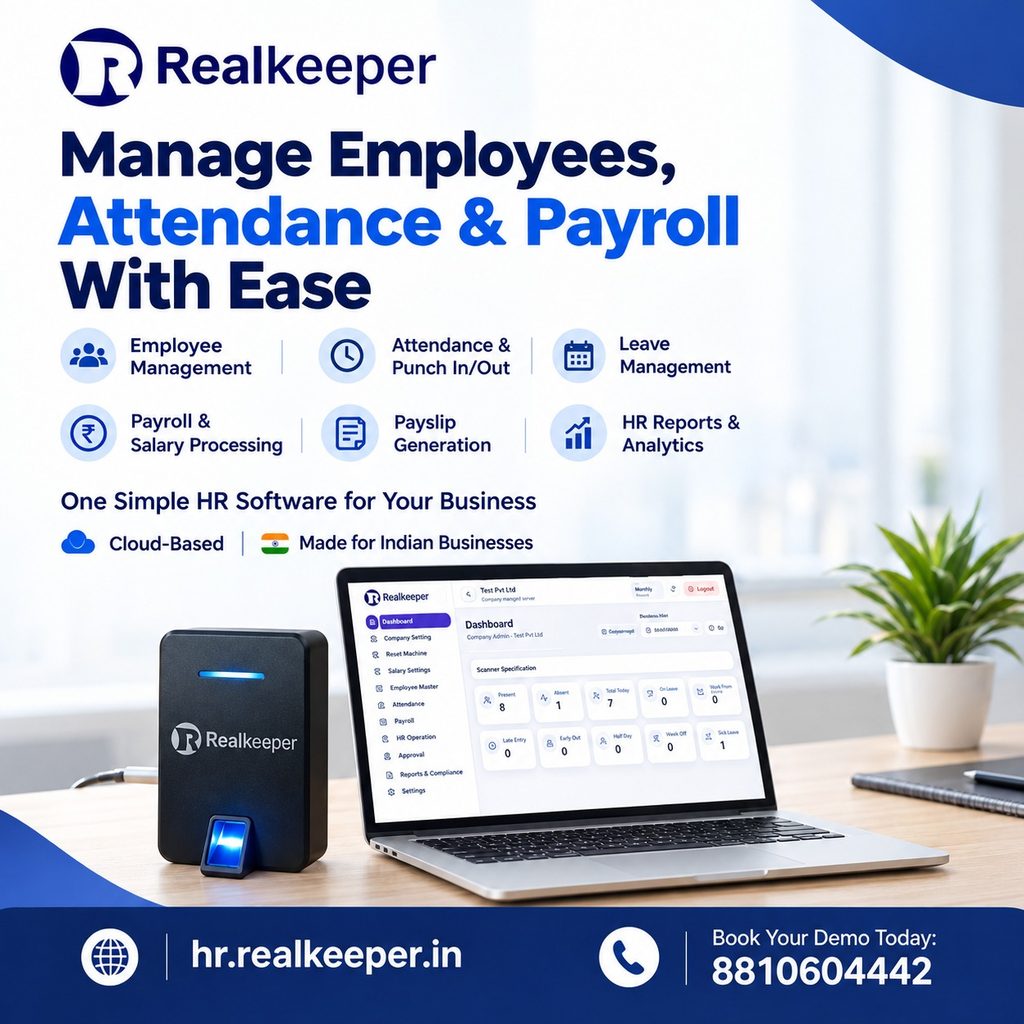
RealKeeper’s HR page specifically highlights an attendance machine using biometric technology for recording employee attendance. It also describes automated attendance-related information such as late arrivals, overtime, and working hours calculations, along with attendance reports and cloud-based management.
This can create a workflow where attendance data is recorded digitally instead of depending entirely on manual registers.
For organizations with regular employee punch-in and punch-out requirements, such a setup can make attendance management more structured.
HR & Attendance Software for Indian Businesses
Indian businesses can have very different workforce structures.
A small office may have a few employees, while a manufacturing company may have a larger workforce working across different departments and shifts.
Retail businesses, service providers, schools, factories, and other organizations may also have different attendance and payroll requirements.
A useful HR system should therefore be practical enough for different types of businesses.
RealKeeper positions its HR & Attendance Software for Indian MSMEs, manufacturers, traders, retailers, service businesses, offices, shops, factories, schools, and growing teams.
This makes the platform relevant for businesses looking for a centralized approach to employee and attendance management.
HR & Attendance Software vs Manual Registers
Many businesses still use physical registers and spreadsheets to manage HR activities.
These methods can be familiar, but they can become difficult to maintain when employee numbers increase.
Manual HR Management
- Physical attendance registers
- Separate employee files
- Multiple spreadsheets
- Manual leave records
- Repetitive payroll calculations
- Manual report preparation
- Difficult historical record searches
Digital HR Management
- Centralized employee database
- Digital attendance records
- Punch in/out management
- Organized leave records
- Connected salary information
- Payroll processing
- Payslip generation
- HR reports and dashboards
The objective of digital HR management is not simply to replace a register with software.
The bigger benefit is connecting employee information with attendance, leave, payroll, and reporting so that HR operations can be managed through a more organized workflow.
Cloud-Based HR & Attendance Software
Cloud access can be useful for businesses where owners and managers need to access HR information from different locations.
RealKeeper describes its HR solution as cloud-based, and states that authorized users can access employee and HR information through supported devices when required.
This can be particularly useful when the business owner is travelling, working from another location, or managing multiple business operations.
Instead of depending entirely on one office computer or physical attendance records, authorized users can work with available digital HR information through the cloud.
Important Features to Look for in HR & Attendance Software
Before choosing an HR & Attendance Software platform, businesses should consider whether it actually supports their daily requirements..
Employee Management
The system should provide a structured employee database with relevant employee and work information.
Attendance Management
Daily attendance should be easy to record and review.
Punch In/Out
Businesses that track employee working time should consider punch in and punch out capabilities.
Late and Early Tracking
The ability to monitor late arrivals and early departures can provide better attendance visibility.
Leave Management
The system should help maintain leave requests, records, balances, and approvals.
Salary Structure
Businesses should be able to maintain employee salary information in an organized manner.
Payroll Management
Payroll functionality should help organize monthly salary processing.
Payslip Generation
Digital payslip generation can reduce repetitive HR administration.
HR Reports
Reports should provide useful information about attendance, leave, salary, and workforce activity.
Cloud Access
Cloud-based access can provide additional flexibility for authorized users.
Ease of Implementation
The software should be practical to configure for employees, departments, attendance settings, and salary structures.
How RealKeeper HR Works
RealKeeper follows a simple three-step implementation approach for its HR & Attendance Software.
First, the business configures company information, departments, designations, attendance settings, and HR preferences.
Next, employees are added and their salary, attendance, and leave information can be configured.
Finally, the business can begin daily HR operations such as tracking attendance, managing leave, and processing monthly payroll.
This creates a straightforward workflow:
Configure Company → Add Employees → Start Daily HR Operations
For businesses moving from manual HR processes to digital management, a structured implementation process can make the transition easier.
One HR Platform for Growing Businesses
One of the useful aspects of an integrated business platform is that HR does not necessarily have to remain isolated from other business operations.
RealKeeper describes its HR system as working alongside accounting, CRM, inventory, and other RealKeeper modules.
This creates the possibility of managing different areas of the business through a broader platform instead of maintaining completely separate systems.
For example:
HR + Accounting + CRM + Inventory + Business Operations
can work as connected business functions.
This can be especially useful for growing businesses that want to reduce the number of disconnected software tools they use.
Who Can Benefit From HR & Attendance Software?
HR & Attendance Software can be useful for many types of organizations.
Offices
Manage employee records, attendance, leave, and payroll in one system.
Manufacturing Businesses
Manage employee attendance and payroll alongside broader business operations.
Retail Businesses
Maintain employee information and attendance for store teams.
Service Businesses
Organize workforce information, attendance, leave, and salaries.
Schools and Institutions
Manage employee attendance and HR records through a digital system.
Growing MSMEs
Build a more organized HR process as the workforce increases.
How to Choose the Right HR System
Choosing software should begin with the organization’s actual HR requirements.
Ask these questions before selecting a solution:
How many employees do we manage?
The number of employees determines how important centralized employee records and scalable HR processes are.
How is attendance currently recorded?
If the business uses registers or spreadsheets, digital attendance can reduce repetitive administrative work.
Do we need punch in/out tracking?
If working hours are important, punch in/out and attendance records should be considered.
How are leaves managed?
If leave information is maintained manually, centralized leave management can make the process more organized.
How is payroll processed?
Businesses should understand their salary structure and payroll requirements before selecting software.
Do we need payslips?
If salary slips are prepared manually, integrated payslip generation can simplify administration.
What reports does management need?
Identify the attendance, leave, salary, and workforce reports that are important for the business.
Do we need cloud access?
For businesses with managers working from different locations, cloud-based HR access can provide additional flexibility.
Final Thoughts
Managing employees becomes increasingly complex as a business grows.
Employee records, attendance, punch in/out, late arrivals, early departures, leave, salary structures, payroll, payslips, and HR reports all need to remain organized.
Managing each activity through separate registers and spreadsheets can create repetitive work and make it harder to maintain a clear view of workforce information.
HR & Attendance Software brings these important HR activities together in one centralized system.
With employee management, attendance tracking, leave management, salary structures, payroll processing, payslip generation, and HR reports, businesses can create a more connected HR workflow.
RealKeeper is designed as a cloud-based HR and attendance solution for Indian businesses and also connects HR operations with its wider business platform, including accounting, CRM, inventory, and other modules.
For businesses looking to move beyond manual registers and scattered spreadsheets, a centralized HR platform can provide a more organized way to manage employees and everyday HR operations.
The goal is simple: manage employees better, track attendance accurately, simplify payroll, and keep your workforce information organized in one place.