
Garment manufacturing has a few problems most other industries don’t: one style can turn into 20 or 30 SKUs once you count every size and color, a big share of the work — cutting, stitching, embroidery — often gets sent out to a job worker, and margins are thin enough that a bit of fabric wastage can wipe out the profit on a batch. There’s no single “best” garment manufacturing ERP software that fits every business. What fits depends on your operation’s size and which of these problems actually cost you money. Here’s what to check before you choose.
What Should Garment Manufacturing ERP Software Actually Do?
At minimum, it should track orders from confirmation to dispatch, keep raw material and finished goods stock updated in real time, generate GST-compliant invoices, and give you a real cost per style — not a guess. Beyond that, most garment units also need to track job-work sent to outside contractors and, ideally, see where a batch is stuck in production. Everything past this point is about how much detail you need, not whether you need ERP software at all.
Why Does Garment Manufacturing ERP Software Need Size and Color-Wise Inventory Tracking?
A single shirt style in 5 sizes and 4 colors is already 20 SKUs before you’ve made a single piece. Generic inventory software that tracks one stock count per style will overstate what you actually have available to sell, because it can’t tell you that you’re out of size M in blue while size L in black is sitting untouched. This is exactly the kind of detail that dedicated apparel and garment ERP systems are built around, with a size-color matrix baked into the product structure rather than bolted on afterward.
Does Garment Manufacturing ERP Software Need to Track Job Work and Subcontracting?
For most small and mid-size units, yes. Cutting, stitching, embroidery, and washing frequently go to an outside contractor, and it’s easy to lose track of how much fabric left the factory and how many finished pieces came back. ERP software that tracks subcontracting logs both sides of that exchange, so a shortfall shows up immediately instead of at the end of the month when the numbers don’t add up. RealKeeper’s manufacturing module includes subcontracting management for exactly this kind of job-work tracking, though it’s built for general small-scale manufacturing rather than apparel specifically.
How Important Is GST Billing in Garment Manufacturing ERP Software?
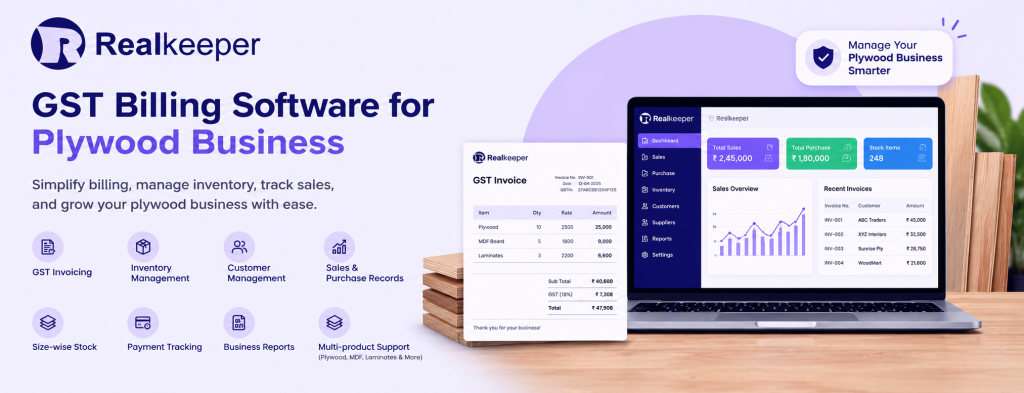
More than in most industries, because the rate itself depends on price. Under the GST reform effective September 22, 2025, garments priced up to ₹2,500 per piece attract 5% GST, while anything priced above ₹2,500 attracts 18%. A manufacturer selling both budget and premium pieces needs software that applies the right slab automatically on every invoice line — getting this wrong at scale becomes a compliance problem, not just a rounding error. RealKeeper’s billing module applies GST rates automatically and generates e-invoices and e-way bills from the same production data, so the numbers on an invoice match what was actually made and shipped.
Can Garment Manufacturing ERP Software Track the Real Cost of a Garment, Including Cutting Wastage?
It should, because fabric wastage during cutting is one of the highest hidden costs in garment production. If a batch is quoted assuming 8% wastage but actually runs at 15%, the job may be losing money without anyone noticing until the accounts are reconciled. Software that logs scrap and production cost against each batch — which RealKeeper does at a general manufacturing level — gives you that number in real time instead of finding out weeks later.
Is RealKeeper a Good Garment Manufacturing ERP Software Option for Small Businesses?
For GST billing, job-work tracking, and general production cost visibility, yes — it covers the essentials at a low cost, and the manufacturing features sit on the Ultimate plan (₹18,000 per year plus 18% GST) alongside WhatsApp CRM and an e-commerce storefront. What it doesn’t offer is a size-and-color inventory matrix or stage-wise cutting-and-stitching tracking built specifically for apparel. If your business runs a handful of styles with straightforward job-work, RealKeeper’s general manufacturing module is a reasonable, affordable starting point. If you’re running many styles across a full size-color grid with a multi-stage factory floor, a dedicated apparel ERP will likely serve you better.
What This Looks Like at Different Scales
A small unit making 3–4 styles with a couple of job-work partners can usually run GST billing, job-work tracking, and cost tracking through a general tool like RealKeeper without hitting its limits. A larger factory running 30+ SKUs per style, with in-house cutting, stitching, and finishing lines, tends to outgrow that setup fairly quickly and needs the size-color and stage-tracking features that dedicated garment ERPs are designed around.
What Other Garment Manufacturing ERP Software Options Should You Compare?
Broadly, options fall into two categories. Dedicated apparel and garment ERP systems — providers such as LOGIC ERP, VRS Software, and Aptean build specifically around size-color matrices, cutting and stitching stage tracking, and product lifecycle management for fashion brands. General small-business ERP and billing tools — including RealKeeper, Tally, Vyapar, and Busy — cover GST billing, inventory, and basic production tracking well, without garment-specific depth. The right comparison depends on which list your business actually belongs to.
What Should You Check Before Choosing Garment Manufacturing ERP Software?
Here’s a quick way to see where a general tool like RealKeeper fits against typical garment manufacturing needs:
| What to Check | Why It Matters for Garment Manufacturing | Does RealKeeper Cover This? |
| GST billing with correct price-based slabs | Garments are taxed differently above and below ₹2,500 per piece | Yes — applies GST automatically and generates e-invoices/e-way bills |
| Real-time raw material & finished goods stock | Fabric, trims, and finished pieces move fast across multiple orders | Yes — updates live, viewable from any device |
| BOM and production tracking | Every style needs its own bill of materials and cost tracking | Yes, on the Ultimate plan (MSME Manufacturing) |
| Job-work / subcontracting tracking | Cutting, stitching, or embroidery is often outsourced | Yes — subcontracting management is built into the manufacturing module |
| Size and color-wise inventory matrix | One style can multiply into 20–30 SKUs across sizes and colors | Not specifically built for this — general SKU tracking only |
| Cutting and stitching stage-wise tracking | Helps spot where a batch is stuck in production | Not specifically built for this |
| Piece-rate payroll for tailors | Many units pay workers per piece, not a flat salary | General payroll only, not a dedicated piece-rate system |
| WhatsApp order updates & CRM | Buyers and retailers expect quick status updates | Yes — WhatsApp CRM is built in |
Frequently Asked Questions
What is the best garment manufacturing ERP software?
There isn’t one single best option — it depends on your scale. Small units mainly need GST billing, basic production tracking, and job-work management, which general tools like RealKeeper cover. Larger factories running size-and-color matrices across many styles usually need a dedicated apparel ERP built for that level of detail.
Do small garment manufacturers really need ERP software, or is Excel enough?
Excel works until order volume or SKU count grows past what one person can track manually. Once GST billing, job-work, and stock updates start happening daily, ERP software removes the errors that spreadsheets are prone to.
What GST rate applies to garments in an ERP invoice?
Since the GST reform effective September 22, 2025, garments priced up to ₹2,500 per piece attract 5% GST, and garments priced above ₹2,500 per piece attract 18% GST. ERP software should apply the correct slab automatically based on the sale price.
Can general small-business ERP software like RealKeeper work as garment manufacturing ERP software?
It can handle the basics well — GST billing, real-time inventory, BOM and production tracking, and subcontracting. It does not specifically offer size-and-color matrix inventory or stage-wise cutting and stitching tracking, so very large or complex garment operations may need a dedicated apparel ERP instead.
Does garment manufacturing ERP need a barcode or size-color matrix?
It helps once you’re running several styles across multiple sizes and colors, since that can multiply into dozens of SKUs per style. Smaller units with fewer style variations can often manage with simpler SKU-based tracking.
How much does ERP software cost for a small garment manufacturing business?
Pricing varies by vendor and features. RealKeeper’s plans, for example, range from ₹5,000 per year for basic GST billing to ₹18,000 per year for the Ultimate plan, which adds MSME manufacturing, WhatsApp CRM, and e-commerce, plus 18% GST.
So, Which ERP Should You Actually Choose?
Match the tool to your actual production complexity, not the other way around. If your biggest headaches are GST billing, tracking job-work, and knowing your real cost per batch, a general tool built for small manufacturers, such as RealKeeper, is a reasonable and affordable place to start — you can explore its plans at realkeeper. in. If you’re managing a full size-color grid across a multi-stage factory floor, weigh that against a dedicated apparel ERP before committing.