
Machinery manufacturing involves hundreds of parts—castings, motors, bearings, fasteners—that must come together on schedule, be billed at the right GST rate, and reach the buyer with matching paperwork.
Spreadsheets and manual registers hold up for a while, but they crack as order volume and part count grow, and more than one vendor or job worker gets involved. Manufacturing software for machinery manufacturers fixes that by bringing production, inventory, and billing into one system. Here’s what to look for in 2026.
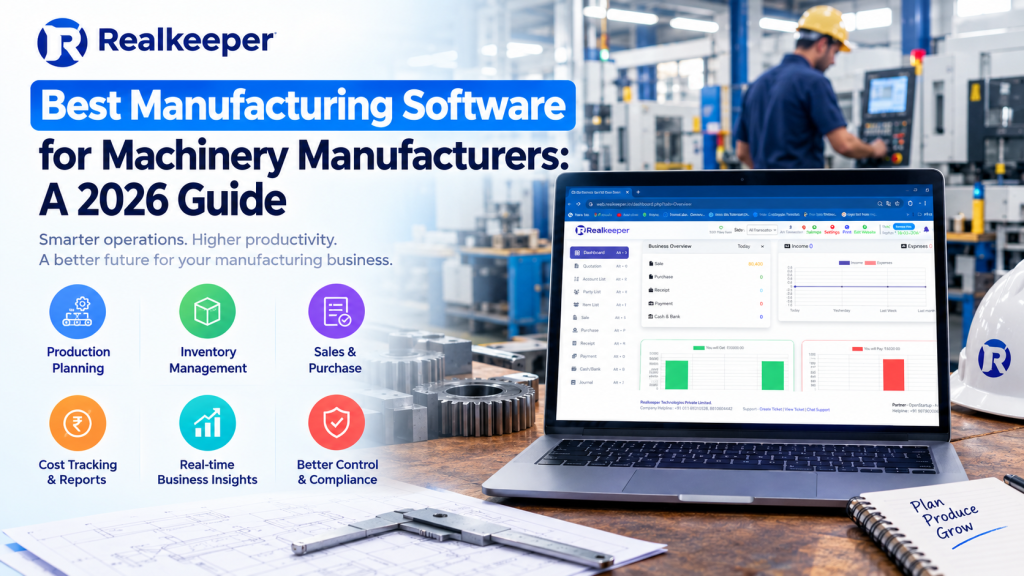
1. How Does Manufacturing Software Reduce Errors in Machine Assembly?
A machine is really a long list of parts — castings, motors, bearings, fasteners, wiring — and building that list by hand invites mistakes. Manufacturing software for machinery manufacturers generates the Bill of Materials once and keeps it tied to live inventory, so what’s on paper matches what’s on the shop floor.
For a business running several machine models at once, that alone removes a lot of guesswork and stops an assembly line from stalling because nobody noticed a bearing or a motor had run out. Over a year, that can save several days of downtime spent chasing missing parts instead of building machines.
2. Does Manufacturing Software Handle GST Billing for Machinery Automatically?
It should, and the rate itself depends on what you make. Most general industrial and manufacturing machinery is taxed at 18% GST following the September 2025 reform, while tractors and farm machinery were moved to a lower 5% slab under the same reform.
A manufacturer selling across both categories needs billing software that applies the correct rate automatically on every invoice line. RealKeeper’s billing module does this while generating e-invoices and e-way bills straight from production data, so the numbers on an invoice match what was actually made and shipped.
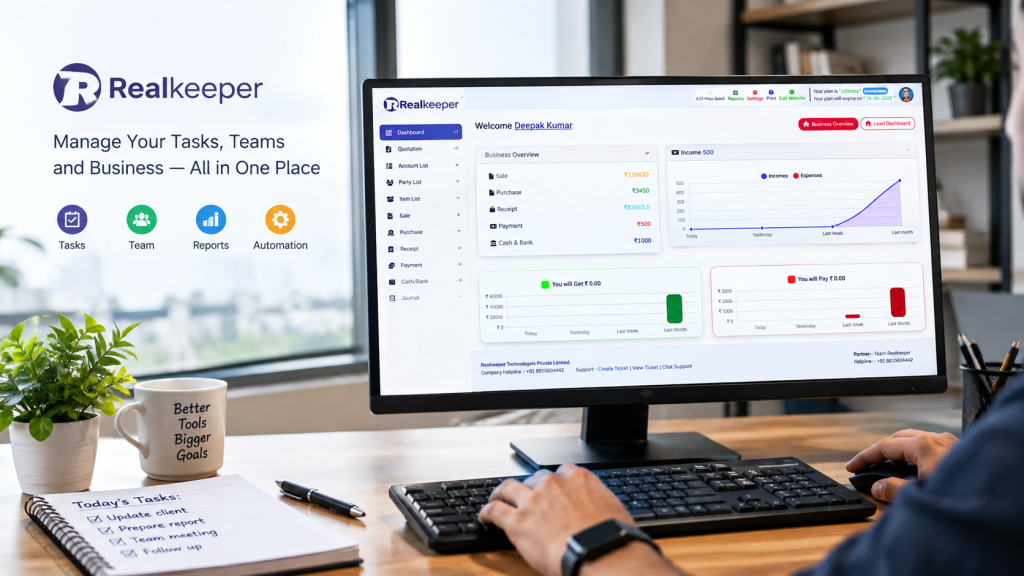
3. Can Manufacturing Software Track Real-Time Stock of Parts and Raw Materials?
Running out of one casting or a specific motor size can stall a full assembly line. Real-time inventory tracking shows exactly what raw material you have, what’s committed to open orders, and what needs reordering, updated the moment a transaction happens rather than at month-end.
That visibility works from a phone too, so you can check stock during a supplier visit instead of waiting until you’re back at the shop floor. It also cuts down on last-minute emergency orders placed in a panic because nobody noticed stock running low a few days earlier.
4. How Does Manufacturing Software Speed Up Production Planning for Custom Machines?
Machinery businesses often build to order — a specific capacity, a custom attachment, a particular motor rating. Made-to-order workflows let you plan a job against actual material availability before you commit to a delivery date.
RealKeeper also tracks purchase requisitions, so procurement starts the moment a shortfall shows up, instead of a week later when someone finally checks the shop floor. That matters more when a single machine might need dozens of parts sourced correctly and on time, and a delay on any one of them pushes back the whole delivery.
5. Can Manufacturing Software Calculate the True Cost of a Machine?
Most small manufacturers price a machine on a rough estimate, because working out the real cost by hand takes too long for every order. Software that tracks production cost, scrap, and subcontracting activity gives you the actual number instead of a guess.
If wastage on raw steel or a costly outsourced machining job is quietly eating into margin, you’ll see it in the data — not months later when the accountant flags a thinner-than-expected margin. That’s the difference between quoting your next order on what a job should cost and what it actually did cost last time.
6. Does Manufacturing Software Help With Job-Work Like Machining and Fabrication?
A lot of machinery work — precision machining, fabrication, painting, heat treatment — gets sent out to job workers, and it’s easy to lose track of what left the factory and what came back. Manufacturing software for machinery manufacturers that tracks subcontracting logs on both sides of that exchange, so a shortfall is visible immediately rather than at month-end reconciliation.
RealKeeper’s manufacturing module includes subcontracting management for exactly this kind of job-work tracking, alongside WhatsApp updates so a dealer or buyer asking about an order gets an answer in minutes rather than after several phone calls back and forth. Payment reminders can go out the same way, instead of depending on someone remembering to call every overdue account.
7. Can You Manage a Machinery Business From Anywhere?
An owner shouldn’t need to be at the factory to approve a purchase order or check today’s production numbers. Cloud-based manufacturing software for machinery manufacturers runs on desktop, tablet, and mobile, so reports — profit and loss, stock ledgers, GST filings — are available from wherever you are.
That matters for machinery businesses in particular, since owners often split time between the shop floor and client sites for installation or service visits. A second location or a new supervisor needs only a login, not a whole new system, which keeps growth from turning into an IT headache.
Is RealKeeper a Good Fit for Machinery Manufacturers?
As manufacturing software for machinery manufacturers, RealKeeper covers the essentials well — GST billing, real-time inventory, BOM tracking, and job-work management — affordably, with manufacturing features sitting on its Ultimate plan (₹18,000 per year plus 18% GST) alongside WhatsApp CRM and an e-commerce storefront.
What it doesn’t offer is a dedicated module for serial-number warranty tracking or after-sales service and AMC scheduling, which larger machinery manufacturers often need. A small or mid-size unit building a handful of machine models will find RealKeeper a solid, affordable starting point.
Where a General Tool Like RealKeeper Fits
Here’s a quick checklist for choosing manufacturing software for machinery manufacturers, and where RealKeeper actually stands:
| What to Check | Why It Matters for Machinery Manufacturing | Does RealKeeper Cover This? |
| GST billing at the correct rate | General machinery is taxed at 18%; farm machinery at 5% | Yes — applies GST automatically and generates e-invoices/e-way bills |
| Real-time raw material & finished goods stock | Castings, motors, and parts move across many SKUs | Yes — updates live, viewable from any device |
| BOM and production tracking | Every machine model needs its own parts and cost list | Yes, on the Ultimate plan (MSME Manufacturing) |
| Job-work / subcontracting tracking | Machining, fabrication, or painting is often outsourced | Yes — subcontracting management is built into the manufacturing module |
| Serial number / warranty tracking | Machines are typically sold with individual warranties | Not specifically built for this |
| Installation & after-sales service tracking | Many machinery sales include on-site setup and AMC | Not specifically built for this |
| WhatsApp order updates & CRM | Dealers and buyers expect quick status updates | Yes — WhatsApp CRM is built in |
Frequently Asked Questions
What is the best manufacturing software for machinery manufacturers?
The best manufacturing software for machinery manufacturers depends on your scale. Small and mid-size manufacturers mainly need GST billing, real-time inventory, BOM tracking, and job-work management, which general tools like RealKeeper cover well. Larger manufacturers needing serial-number warranty tracking may need a more specialised system alongside it.
What GST rate applies to machinery in 2026?
Most general industrial and manufacturing machinery is taxed at 18% GST following the September 2025 reform. Tractors and farm machinery were moved to a lower 5% GST rate under the same reform.
Can manufacturing software track parts like castings, motors, and components?
Yes. A Bill of Materials tied to live inventory shows exactly which parts and raw materials are in stock and which are running low, so production doesn’t stall over a missing part.
Does RealKeeper support serial number or warranty tracking for machines?
No, not specifically. RealKeeper covers GST billing, inventory, BOM and production tracking, and subcontracting, but it does not offer a dedicated module for serial-number warranty tracking or after-sales service scheduling.
How much does manufacturing software cost for a small machinery business?
Pricing varies by vendor and features. RealKeeper’s plans, for example, range from ₹5,000 per year for basic GST billing to ₹18,000 per year for the Ultimate plan, which adds MSME manufacturing, WhatsApp CRM, and e-commerce, plus 18% GST.
Can I try manufacturing software before switching my machinery business to it?
Most vendors offer a trial period. RealKeeper gives a free 7-day trial with no credit card required, so you can test the billing and manufacturing modules on your own data first.
So, Is Manufacturing Software Worth It for Your Machinery Business?
If GST billing, part-level inventory, and job-work tracking are your biggest daily headaches, manufacturing software for machinery manufacturers pays for itself quickly. RealKeeper covers these essentials at a low cost — explore its plans at realkeeper.in. If your business also needs serial-number warranty tracking or after-sales service scheduling, weigh that gap before making the switch.