
Interior Design Accounting Software: 2026 Buyer’s Guide
A client wires ₹500,000 as an advance. Two weeks later, you raise a purchase order for a sofa you haven’t billed yet, and your bookkeeper asks whether that advance counts as income. It doesn’t, and that gap between cash received and revenue earned is the reason interior design accounting software exists. This guide covers what to look for, how the main tools compare, and what Indian studios should check for GST before they buy.
[Insert Image 1 here: hero image. See the image notes.
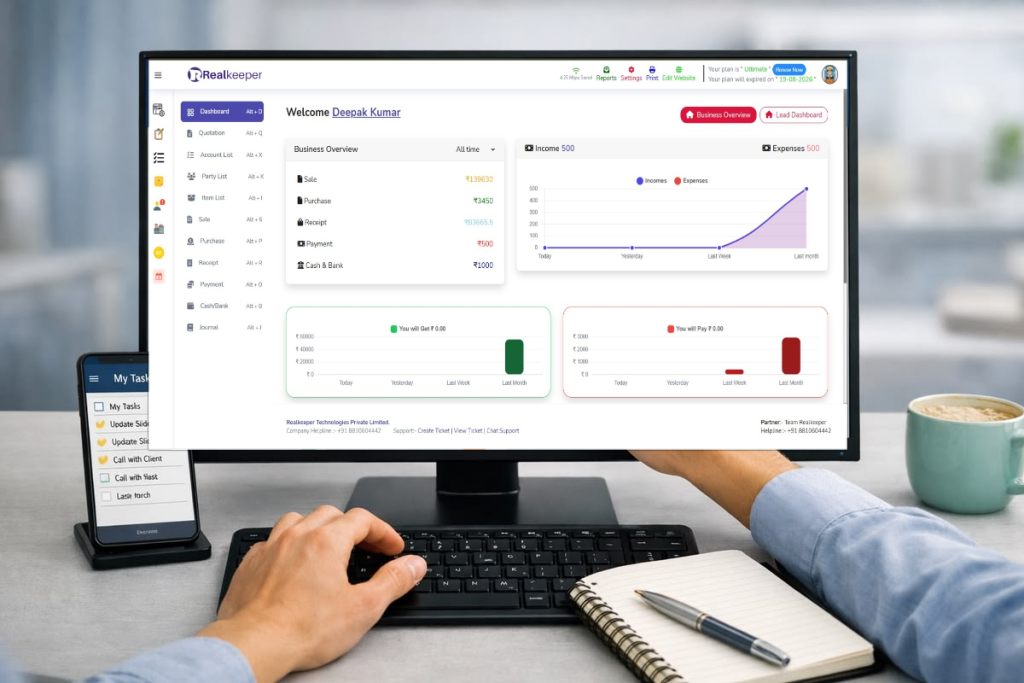
What is interior design accounting software?
Interior design accounting software is a financial system built around the way design firms actually bill: retainers and deposits, vendor purchase orders, trade discounts and markups, and profit tracked project by project. It comes in two forms. Platforms such as Studio Designer and Design Manager put project management, procurement, and a full accounting ledger in one product. The alternative is a general ledger (QuickBooks, Xero, Zoho Books, or TallyPrime) paired with a design-specific tool for proposals and purchasing.
Neither form is automatically better. The right one depends on how much product you buy on clients’ behalf, how many people touch the books, and which country’s tax rules you work under. If you’re still weighing a ledger against a full platform, Realkeeper’s guide to accounting software for small businesses covers the general checklist.
Why can’t ordinary bookkeeping software handle a design studio?
General accounting tools assume a simple sale: you invoice, the customer pays, and you record revenue. A design studio runs four financial jobs at once. It sells design time, buys goods for clients, holds large deposits before work begins, and earns margin from the gap between trade price and client price.
[Insert Image 2 here: money-flow diagram.] See the image notes.]
Each job creates its own way to get interior design bookkeeping wrong. Three mistakes show up in nearly every studio’s books:
- Deposits booked as income. An advance is a liability until you earn it. If it lands in revenue, profit looks inflated until the work catches up, and your tax position is misstated.
- Markup counted twice. Say you buy a sofa at a trade price of ₹140,000 and bill the client ₹175,000. Revenue is ₹175,000, cost is ₹140,000, and margin is ₹35,000. Add a separate ₹35,000 “procurement fee” on top and the P&L shows ₹210,000 of revenue from a ₹1,75,000 sale.
- Purchase orders that never reconcile. Bookkeepers who work with design firms name purchase orders as the usual reason a studio’s books don’t add up. Their advice is to review open POs every two weeks while a project runs.
Which features matter most in interior design accounting software?
Start with the features that match how money moves through a project. A polished client portal is nice. Correct deposit and purchase-order handling is not optional.
| Feature | Why it matters | What to test in a demo |
| Project-level accounting | Every deposit, PO and invoice must attach to one client project so you can see true profit per job. | Open a past project and ask for its profit and loss in under a minute. |
| Deposit and retainer handling | Advances must sit as liabilities and be applied against later invoices. | Record a ₹5,00,000 advance, then apply ₹1,50,000 to a milestone invoice. |
| Purchase orders linked to client items | Stops orders that were placed but never billed. | Create a PO and confirm it appears on an open-PO report. |
| Trade discount and markup rules | Lets you bill at list, at cost-plus or with a shared discount without double counting. | Bill one item three ways and compare revenue, cost and margin. |
| Milestone and progress invoicing | Design and execution are billed in stages, and payment reminders stop a late milestone from stalling a site. | Raise a 30/40/30 schedule on one contract. |
| Time tracking | Needed for hourly or hybrid design fees. | Log hours against a task and turn them into an invoice line. |
| Reports | Project profitability, open POs and receivables ageing drive your decisions. | Request all three, filtered by project and date. |
| Export and integrations | Your accountant may work in Tally, QuickBooks or Xero. | Export a month of data and have your CA review it. |
| Tax handling for your country | GST in India, sales tax in the US, VAT elsewhere. | Issue a tax invoice for a project in another state or region. |
What does an Indian interior design studio need from accounting software?
Indian studios need software that issues correct GST invoices, separates design fees from execution work, picks the right tax type by project location, and tracks TDS deducted by clients. Many design-specific platforms were built around US sales tax, so this is where you should test hardest. A dedicated GST billing software covers the invoice side; the table shows what a design studio must confirm on top of that.
The table lists what to check, based on current GST and income tax guidance. Rates and thresholds change, so confirm each point with your chartered accountant before relying on it.
| Requirement | What the software should do |
| 18% GST on design services | Apply 18% under SAC 998391 (specialty design services including interior design) to design fees, concept drawings, 3D views, and supervision. |
| Works contract billing | Bill turnkey fit-out, such as false ceilings, flooring, fixed wardrobes, and electrical or plumbing work as a works contract, is also taxed at 18%, on a line separate from the design fee. |
| Place of supply | Charge CGST and SGST when the property is in your state and IGST when it is in another. Place of supply follows the property’s location, not your studio or your client’s office. |
| Registration threshold | Registration is generally required above ₹20 lakh of annual turnover for service providers (₹10 lakh in a few northeastern states). Your system should let you monitor turnover against that limit. Current rules are on the GST portal. |
| Input tax credit awareness | Business clients generally cannot claim credit on capitalised fit-out works contract services, so quotes should show GST clearly and never promise credit. |
| TDS tracking | Record TDS deducted by company clients (design fees and execution contracts fall under different provisions) and reconcile it with Form 26AS. |
| Invoices and filing | Produce GST-compliant invoices with SAC or HSN codes, support e-invoicing where your turnover requires it, and export data for GSTR-1 and GSTR-3B. |
One change to know about: from 1 April 2026, TDS on both professional fees and contract payments sits under Section 393 of the Income-tax Act 2025 (see the Income Tax Department site), so older templates that cite the previous section numbers may need updating.
Here is why place of supply matters. A Jaipur studio charges ₹300,000 for design work. On a flat in Jaipur, the invoice carries ₹27,000 CGST and ₹27,000 SGST. On a flat in Mumbai, it carries ₹54,000 IGST. The total is ₹3,54,000 either way, but charging the wrong tax type means paying tax twice and then claiming a refund on the wrong one.
[Insert Image 3 here: sample GST invoice. See the image notes.]
Studios with mostly homeowner clients sometimes choose the GST composition scheme: 6% on turnover for eligible service providers up to ₹50 lakh, with no input tax credit and no inter-state supplies. That choice changes how every invoice looks, so confirm your software supports it before you opt in.
How do the leading options compare?
No single tool wins for every studio. The table groups the main options by what they do best. Prices are entry-level figures reported by third-party reviews and vendor pages at the time of research, so check each vendor’s pricing page before you decide. For a wider Indian comparison, see Realkeeper vs TallyPrime, Busy, Vyapar, and Zoho Books.
[Insert Image 4 here: comparison infographic. See the image notes.]
| Tool | Best for | Accounting depth | GST and India fit | Reported entry price |
| Studio Designer | Larger firms with heavy procurement | Full accrual accounting with POs, markup, and project P&L | Built around US practice. Confirm GST support in a demo. | $69–$109 per user/month |
| Design Manager | Firms that rank accounting above design tools | Double-entry accounting, item-based POs, vendor deposit tracking | Aimed at US residential firms. Confirm GST support. | About $79 per user/month (older pages list lower) |
| Programa | Visual, procurement-led boutique studios | Procurement and invoicing, lighter accounting | Not verified. Ask the vendor. | $59–$63 per seat/month (sources differ) |
| QuickBooks Online | Studios whose accountant already uses it | General ledger with job costing | Depends on the regional edition. Verify for India. | Varies by region |
| Zoho Books | Small and growing Indian studios | General ledger, project billing on higher plans | Strong: GST billing and return filing from the software | Free plan for small businesses; paid tiers vary. |
| TallyPrime | Studios whose CA works in Tally | Deep accounting, widely used by Indian accountants | Strong GST compliance | Silver rental is reported to be about ₹750 + GST/month. |
| Realkeeper | Indian studios wanting GST billing, books, payment reminders, and CRM in one cloud system | Double-entry accounting with sales, purchases, receipts, payments, and financial reports. Project-level costing is not stated on public pages. | GST billing and GST reports. Confirm place-of-supply and TDS handling in a demo. | From ₹5,000/year + 18% GST, as listed on the site; see pricing. |
| Vyapar and Swipe | Solo designers who need fast GST quotes and invoices | Billing-first, limited project accounting | GST invoices, quotations, and e-invoicing | Low-cost to free entry plans; Vyapar reported near ₹3,599/year. |
Studio Designer and Design Manager are the two purpose-built platforms that combine project management with real accounting. Everything else is either a ledger or a front end, which means you assemble the system yourself.
Where does Realkeeper fit for an interior design studio?
Realkeeper is a Delhi-based cloud platform for GST billing, accounting, and CRM, designed for small and medium Indian businesses. It suits interior design studios that need GST-ready invoices, double-entry books, payment follow-up, and lead tracking in one place, rather than a US-built procurement suite.
Here is what its public pages confirm. You can enter sales, purchase, receipt, payment, and bank vouchers and let the software post the double entries. You get financial reports including profit and loss, balance sheet, trial balance, cash flow, ledger, day book and GST reports. There is a payment reminder system for outstanding invoices, a CRM with WhatsApp for leads, and access from mobile, desktop, and the web. Entry plans start at ₹5,000 a year plus 18% GST for two users, and the site offers a 7-day free trial.
What those pages do not state is design-specific project costing, such as purchase orders tied to client items or markup tracking. If you need that, ask for exactly that workflow in a demo and use the test steps in the next sections. If your studio also sells materials such as plywood, laminates, or hardware, Realkeeper’s plywood billing software page covers size-wise stock and square-foot billing.
Which software suits which type of studio?
- Solo designer or small Indian studio billing mostly design fees: Start with a GST-ready cloud ledger such as Zoho Books or Realkeeper, or a billing-first tool such as Vyapar, plus a quotation template (Realkeeper has a free quotation tool). A US-built procurement suite is more system than you need and may not match GST workflows.
- Indian turnkey studio with vendors and subcontractors: Choose a ledger-first tool (TallyPrime, Zoho Books or a cloud ERP such as Realkeeper; this guide to ERP software for small business in India explains what to check), set up one project or cost centre per client from day one, and track purchase orders in a disciplined sheet until volume justifies more. Hire a bookkeeper who has worked with design firms.
- Full-service firm with heavy furniture, fixtures and equipment buying, mainly outside India: Studio Designer or Design Manager earns its cost, because purchase orders, trade pricing and deposits are exactly what they are built for.
- Studio whose accountant mandates a specific ledger: Pick a design front end that exports cleanly to that ledger, and test the export before you sign.
One honest caveat. We could not verify native GST invoicing in the US-built platforms from public sources. If you are in India, make a live demo that issues an IGST invoice a condition of purchase, whichever vendor you pick.
How should you test software before you buy?
- Map your money flows. List how a typical project moves: deposit, design-fee milestones, purchase orders, vendor deposits, final invoice.
- Run one finished project through a trial. Use real numbers from a project you have already closed and compare the software’s profit figure with what you know happened.
- Check three reports. Profit by project, open purchase orders, and receivables ageing. If any is missing or needs a workaround, write that down.
- Test the export. Send a sample month to your accountant and ask whether it is usable without rework.
- Count the full cost. Include per-user fees, onboarding, data migration, and the bookkeeper time needed to keep the system running.
What setup mistakes cost studios the most?
- Recording deposits as revenue instead of liabilities.
- Booking markup as a separate income line on top of the invoiced price.
- Leaving purchase orders open without matching them to vendor bills.
- Burying reimbursable costs such as freight and samples in overhead, which hides real project margins.
- Issuing one lump-sum invoice for design and execution in India. Clients then struggle to apply the right TDS, and your fee income gets mixed with contract income.
Frequently asked questions
What is interior design accounting software?
Interior design accounting software is a financial tool that handles client deposits, vendor purchase orders, trade discounts, markups, and project-level profit for design firms. Some products combine accounting with project management, while others connect a design front end to a general ledger such as QuickBooks, Zoho Books, or TallyPrime.
Can I use QuickBooks or Tally for an interior design business?
Yes, as a ledger. You will need a liability account for client deposits, a way to track each project through classes, jobs or cost centres, and a separate process or companion tool for purchase orders. Studios with heavy product buying often outgrow this setup.
What GST rate applies to interior design services in India?
Interior design services under SAC 998391 are taxed at 18% GST, and interior works contracts that combine materials and labour are also taxed at 18%. Rates are revised from time to time, so confirm the current notification with your chartered accountant.
How should interior designers record client advances?
Record an advance as a liability, such as client deposits or unearned revenue, and move it into revenue as you earn it through milestones or deliveries. In India, ask your accountant how GST applies to advances under your contracts and whether you need to issue an advance receipt voucher.
Is there free accounting software for interior designers?
Several general tools offer free or low-cost plans, including Zoho Books for small Indian businesses and Wave in some regions. These cover invoicing and basic bookkeeping, but not the deposit and purchase-order workflows built for design firms. Realkeeper offers a free 7-day trial and a free quotation tool. Check each vendor’s current limits before relying on a free plan.
When does a design studio need purpose-built accounting software?
When several projects run at once, you buy goods on clients’ behalf, and month-end reconciliation of deposits and purchase orders takes days instead of hours. Below that volume, a general ledger with disciplined setup is often enough.
Test two tools on your busiest project
Shortlist two tools and run your busiest recent project through each trial. The one that produces a profit figure you trust, with correct deposits, purchase orders and GST, is the right fit. Start a free 7-day Realkeeper trial or talk to the Realkeeper team to see how your studio’s deposits, invoices, and GST would run in the software.