
Your BOM says 100 moulded parts need 10 kg of granules. Stores issued 11.4 kg, nobody noted the return of the leftover bag, and the job closed at a profit that exists only on paper. Raw material consumption tracking software records what each job actually uses, compares it with the BOM, and shows the gap in kilos and in rupees.
Full disclosure: we build Realkeeper, a Delhi-based cloud ERP and CRM with manufacturing, BOM, production costing and GST billing. We’ve included it in the comparison and said plainly where another tool fits better. This guide covers how raw material consumption tracking works, the variance maths, India’s compliance angle, software options and costs.
What is raw material consumption tracking software?
Raw material consumption tracking software records the material issued to each production job, the material actually used, and the difference from the BOM standard, so stock, cost and wastage reports reflect what really happened on the floor. It turns “we lose some material” into a number you can act on.
| Term | Meaning | Why it matters |
| Standard (BOM) quantity | The material a product should use, including planned scrap | The benchmark for every job |
| Issue | Material moved from stores to the production floor | Over-issue is the quiet source of waste |
| Consumption | Material actually used by the job | The figure that drives cost and stock |
| Backflush | Stock deducted automatically from the BOM when output is booked | Fast, but it assumes the BOM is true |
| Quantity variance | Actual quantity minus standard quantity | Shows waste, errors and bad standards |
| Price variance | Difference between actual and standard purchase price, times quantity used | Separates buying problems from floor problems |
Why does raw material consumption tracking software matter for Indian factories?
For most manufacturers, raw material is the largest cost line, so a small consumption gap repeats across every job, which is what raw material consumption tracking software is built to catch. The Ministry of Statistics publishes materials consumed by industry and state in its Annual Survey of Industries, which shows how central materials are to factory economics.
Three pressures make raw material consumption tracking software more than a nice-to-have:
- Margin: quotes are built on BOM cost, so unrecorded excess consumption quietly eats the profit you thought you priced in
- Cost records: companies in notified sectors with turnover of ₹35 crore or more must keep cost records in Form CRA-1 under the Companies (Cost Records and Audit) Rules, 2014, which cover utilisation of material
- GST: input tax credit on goods that are lost, stolen, destroyed or written off can be blocked, so you need a record of what was lost and why
The Rules are summarised in an ICMAI document and in Tally’s cost audit guide.
Backflush or actual issue: which method suits raw material consumption tracking software?
Use backflushing for stable, low-variance materials, actual issue for expensive or volatile ones, and a hybrid of both with tolerance limits for most factories. Pure backflushing assumes the BOM is right, which is exactly what you’re trying to test.
| Method | How it works | Best when | Weakness |
| Backflush (BOM-based) | Stock reduces automatically from the BOM when output is booked | Stable products, low-value inputs | Hides over-use, because actual equals theoretical by design |
| Actual issue against work order | Stores issues real quantities to each job, and returns are booked | Costly or variable materials | Needs operator discipline and fast data entry |
| Hybrid with tolerance | Backflush by default; actual issue for critical items; approval above a tolerance | Most MSME factories | Needs set-up of tolerance per material |
| Weigh and scan | Scales or barcodes capture real quantities at the machine | Bulk, process and moulding units | Hardware cost and training |
Our view: start with a hybrid setup in your raw material consumption tracking software. Backflush everything, then switch the three or four costliest materials to actual issue. That covers most of the money for a fraction of the data entry.
How does raw material consumption tracking software work, step by step?
The cycle runs from standard to correction: set the BOM, receive material, issue it, record what was used, compare with the standard, and fix the cause. Each step should update the same record.
- Set standards. Enter BOM quantities per product, including a planned scrap allowance.
- Receive and tag material. Book the goods receipt with batch or lot numbers and the purchase price.
- Issue against a work order. Stores issues material to a specific job, and any quantity above the BOM needs approval.
- Record actual use. Capture consumption and return unused material to stock.
- Book output, scrap and by-products. Good pieces, rejects and recoverable offcuts all get quantities.
- Compare actual with standard. Read the quantity and price variance per material and per job.
- Act on it. Fix the BOM if the standard was wrong, or fix the process, setting or habit if the standard was right.
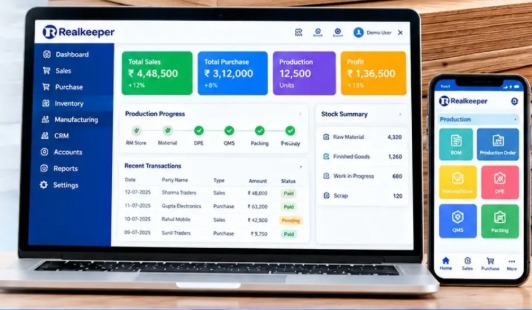
Realkeeper’s production management software covers the production side of this chain: raw material tracking with reorder alerts, job cards and work orders, stage monitoring, output and wastage tracking, and costing for material, labour and overheads.
How do you calculate raw material consumption variance?
Raw material consumption tracking software calculates quantity variance as actual quantity minus standard quantity, and price variance as the price difference multiplied by the quantity actually used. Adding the two gives the total cost variance for the job.
| Line (illustrative job) | Figure | Working |
| Pieces produced | 1,000 | Given |
| Standard use per piece | 0.250 kg | From the BOM |
| Standard quantity | 250 kg | 1,000 × 0.250 |
| Actual quantity used | 268 kg | From stores records |
| Quantity variance | 18 kg (7.2%) | 268 − 250 |
| Standard price | ₹120 per kg | From the BOM costing |
| Actual purchase price | ₹126 per kg | From the goods receipt |
| Quantity variance in rupees | ₹2,160 | 18 × ₹120 |
| Price variance | ₹1,608 | (₹126 − ₹120) × 268 |
| Total material cost variance | ₹3,768 | ₹33,768 actual − ₹30,000 standard |
Notice what the split tells you. ₹2,160 is a floor problem and ₹1,608 is a buying problem. Without both lines, one number hides two different fixes.
Why does actual consumption exceed the BOM?
Actual consumption usually exceeds the BOM because the standard is wrong, material is over-issued, or loss isn’t recorded. Check the BOM before you blame the shop floor.
- Outdated BOM: a design or supplier change was never reflected in the standard
- Setup and trial scrap: machines consume material before the first good piece
- Over-issue “just in case”: extra material leaves stores and is never reconciled
- Unrecorded returns: leftover material sits on the floor, so the job looks heavier than it was
- Process loss: cutting, spillage, evaporation or trimming beyond the allowance
- Unit errors: purchase in bags, issue in kilos, BOM in grams
- Pilferage: the last cause to assume, and the first you can’t rule out without records
Good raw material consumption tracking software logs scrap separately so waste doesn’t disappear into consumption. Realkeeper’s guide to manufacturing scrap tracking software shows how, and its BOM management guide covers keeping standards honest.
What compliance rules should raw material consumption tracking software support?
Four rules shape what your records must show: cost records, ITC on losses, job work goods and scrap sales. Check the details with your chartered accountant, because notifications change.
| Area | What applies (verify before acting) | What your tracking should capture |
| Cost records (CRA-1) | Specified-sector companies with turnover of ₹35 crore or more maintain cost records covering material utilisation; cost audit thresholds are higher | Material issued, used and costed per product |
| Input tax credit on losses | ITC on goods lost, stolen, destroyed or written off can be blocked under Section 17(5)(h) of the CGST Act | Loss quantity, reason and approval |
| Material sent for job work | Goods move on a challan and have return time limits under Section 143 | Quantity at the job worker, kept on your books |
| Scrap sales | Selling scrap is a supply and needs a tax invoice | Scrap stock converted to a sale with the right HSN |
The Acts and Rules are on the CBIC tax information portal, and filing tools are on the GST portal. The same consumption record that feeds costing also gives your CA the trail they ask for.
Which features should raw material consumption tracking software have?
The essentials of raw material consumption tracking software are BOM standards with scrap allowance, issue against work orders, actual-versus-standard variance, wastage capture and batch traceability. Dashboards and AI add-ons matter far less than these.
| Feature | What to check | Why it matters |
| BOM standards | Single and multi-level BOMs, scrap allowance, units of measure and conversions | The benchmark for every variance |
| Issue against work order | Quantities issued to a specific job, with returns booked back | Ties material to the job that used it |
| Backflush and manual issue | Choose per material, or per product | Matches the method to the risk |
| Variance report | Actual versus standard by job, material and period, in quantity and rupees | Shows where money leaks |
| Excess-issue control | Tolerance limits with approval above them | Stops over-issue at the source |
| Wastage and scrap | Scrap, offcuts and by-products logged against the job | Keeps waste visible and valued |
| Batch and lot tracking | Material batch traced to the jobs that consumed it | Supports quality and recalls |
| Stock and reorder alerts | Levels, ageing and reorder points per material | Avoids stoppages mid-job |
| Costing | Material, labour and overhead rolled into job cost | Reveals true margin |
| Capture method | Barcode, scale or mobile entry at the machine | Data entered late is data from memory |
Excel, accounting software or ERP: which fits raw material consumption tracking?
Use Excel only for a handful of simple products, accounting software if you mainly invoice and keep stock, and a manufacturing ERP once production orders, costing and batches need to connect. The wrong level leaves consumption either invisible or buried in features you won’t use.
| Approach | Best when | Watch out for |
| Excel sheet | A few products and a single stores person | No link between BOM, issue and stock; errors multiply with volume |
| Accounting software with production | You invoice, keep stock and file GST in one tool | Check whether it records actual consumption or only backflushes |
| Manufacturing ERP | Work orders, costing and batches must connect | Needs clean item, unit and BOM data before go-live |
| Enterprise ERP with MES | Several plants and machine-level data | Cost, rollout time and partner dependence |
How much does raw material consumption tracking software cost in India?
Pricing for raw material consumption tracking software ranges from free open-source options to one-time licences of about ₹16,500 and published ERP bundles from ₹18,000 a year, with many manufacturing ERPs quoting on request. Implementation and training often cost more than the licence.
| Option | Published pricing (verify) | Consumption relevance |
| BUSY | Standard edition about ₹16,500 one-time | Production features start in Standard; Basic omits them |
| TallyPrime | Rental from about ₹750/month or about ₹18,000 one-time (single user); lists vary | Check how your edition records actual consumption against BOM |
| Zoho | About ₹999 per user/month billed annually, minimum 5 users, on one 2026 list | Lighter manufacturing; check BOM depth |
| Odoo | Standard from about ₹580 per user/month; add-on modules exist for BOM variance | Strong consumption features; needs a partner |
| ERPNext | Free to self-host; managed cloud priced per user | Technical teams only |
| Realkeeper | Ultimate plan ₹18,000 + 18% GST for the first year, ₹12,000 from the next, 5 users. See Realkeeper pricing | BOM, work orders, wastage and costing in one platform |
| Finsys, ERPDrive, other SME ERPs | Quote based | Vendor pages describe theoretical versus actual consumption reports |
Prices come from vendor and comparison pages and change often. Get written quotes, and ask whether the variance report and any barcode or weighing integration are included or add-ons.
Which raw material consumption tracking software fits your factory?
There’s no single best raw material consumption tracking software. Fit depends on your process type, material cost share, volume and how much IT help you have. The names below recur in 2026 vendor and guide material. Treat them as a shortlist, not a ranking, because we haven’t benchmarked these products ourselves.
| Factory profile | Names worth shortlisting | What to test first |
| Trader-manufacturer on accounting software | BUSY Standard, TallyPrime | Whether actual consumption, not just backflush, is recorded |
| MSME manufacturer wanting BOM, production and billing together | Realkeeper, Vyapar, Zoho | One real job from issue to costed output |
| Plastic, rubber or process unit with high material share | Finsys ERP, Odoo | Theoretical versus actual report on your own data |
| Technical team with a partner | ERPNext, Odoo | Variance reporting and India GST localisation |
| Small-batch makers selling online | MRPeasy, inFlow, Craftybase | India GST, e-way bill and rupee costing |
Our view: for most Indian MSME factories, raw material consumption tracking software doesn’t need MES hardware to start. It needs an honest BOM, issue against work orders, and a variance report they actually read each week.
How does Realkeeper compare for raw material consumption tracking?
Realkeeper is a cloud ERP and CRM for Indian MSME manufacturers whose manufacturing module lists BOM, raw material tracking, work orders, wastage tracking and production costing, so it fits factories that want raw material consumption tracking connected to billing and stock. Dedicated process ERPs may go deeper on weighing hardware and variance analytics.
Realkeeper’s manufacturing ERP lists BOM, stock update automation, stock valuation and ageing, automatic alerts, production costing with scrap tracking, subcontract management and a document timeline per transaction. Its production management module adds job cards, work orders, stage monitoring, and output and wastage tracking, and its BOM can carry scrap information. The same platform runs GST billing, and the manufacturing billing software page shows the wider setup.
| Factor | Realkeeper | Accounting-led tools (BUSY, TallyPrime) | Process and open ERPs (Odoo, ERPNext, Finsys) |
| Product type | Cloud ERP and CRM with MSME manufacturing | Accounting and billing with production features | Production-led ERP |
| Best fit | MSME manufacturers on published plans | Traders and small manufacturers | Process-heavy or technical teams |
| BOM and standards | BOM with scrap information | Edition-dependent BOM and production vouchers | Multi-level BOM, tolerances |
| Raw material stock and alerts | Raw material tracking with reorder alerts; stock adjustments | Stock registers and reorder levels | Lot-level stock and alerts |
| Issue to production | Job cards and work orders with stage monitoring | Production vouchers | Manufacturing orders with component issue |
| Actual versus standard variance | [Add your planned-versus-actual consumption report here] | Varies by edition | Variance views and add-ons available |
| Backflush or manual issue | [Add whether consumption is backflushed or issued manually] | Usually backflush | Both, configurable |
| Excess-issue approval | [Add tolerance or approval controls here] | Limited | Tolerance thresholds in some modules |
| Wastage, scrap and costing | Wastage tracking and production costing with scrap tracking | Basic costing | Detailed costing |
| Barcode or scale capture | [Add barcode or weighing support here] | Limited | Scanner and IoT options |
| Pricing model | Published bundles; see compare plans | Licence or rental | Per user or quote |
Choose Realkeeper if you are an MSME manufacturer who wants raw material consumption tracking software, BOM, work orders, wastage, costing and GST billing under one login, and you value a published price. Read Realkeeper vs TallyPrime, Busy, Vyapar and Zoho Books for the accounting-tool comparison.
Choose another option if you run a process plant that needs scale or sensor integration, or you want deep variance analytics and have a partner to configure it. Honest advice: if you make a few simple products, a disciplined Excel sheet with a weekly stock count is enough.
How do you choose raw material consumption tracking software? Seven checks
- Run one real job. Enter its BOM, issue material, book output and read the variance.
- Test a return. Issue 12 kg, use 10 kg, return 2 kg, and check stock and cost.
- Check the method. Confirm you can mix backflush and actual issue by material.
- Test excess issue. See whether a tolerance or approval stops over-issue.
- Trace a batch. Pick a material lot and list the jobs that consumed it.
- Compare costs. Match the system’s job cost with your own sheet, including scrap.
- Calculate three-year cost. Include implementation, training, add-ons, GST and renewals.
Frequently asked questions about raw material consumption tracking software
What is raw material consumption tracking software?
Raw material consumption tracking software records the material issued to each job, the material actually used and the difference from the BOM standard. It keeps stock, cost and wastage reports aligned with what happened on the shop floor.
How do you calculate raw material consumption variance?
Quantity variance is actual quantity used minus standard quantity from the BOM. Price variance is the difference between actual and standard price multiplied by the quantity used. For example, using 268 kg against a 250 kg standard is an 18 kg variance, which is 7.2 percent.
What is the difference between backflushing and actual issue?
Backflushing deducts stock automatically from the BOM when output is booked, so recorded consumption always equals the standard. Actual issue records the real quantities handed to each job, which reveals over-use. Many factories combine both.
How much does raw material consumption tracking software cost in India?
Costs range from free open-source options to roughly ₹580 to ₹999 per user per month for cloud tools, one-time licences of about ₹16,500, and published MSME bundles such as ₹18,000 plus GST for five users. Enterprise platforms quote on request, and implementation is usually extra.
Does raw material consumption tracking software help with GST and cost records?
It helps by keeping a trail of material issued, used, lost and sold as scrap. Companies in notified sectors with turnover of ₹35 crore or more maintain cost records under the Cost Records and Audit Rules, and ITC on lost or written-off goods can be blocked. Confirm your case with a chartered accountant.
Does Realkeeper offer raw material consumption tracking software?
Realkeeper’s manufacturing ERP lists BOM, raw material tracking with reorder alerts, work orders, wastage tracking and production costing, available on the Ultimate plan. Its public pages don’t describe a planned-versus-actual consumption report, so test your own job during the 7-day free trial.
Your next step
Take your last three jobs and compare BOM quantity with what stores actually issued. If you can’t do it in ten minutes, you have a consumption gap worth closing before you shop for raw material consumption tracking software. To see BOM, work orders, wastage and costing connected, start Realkeeper’s 7-day free trial, check plans and pricing, or talk to the team. For related reading, see Realkeeper’s guides to manufacturing expense tracking, GST billing for manufacturing units and ERP software for small business in India.