
Running a plywood business involves much more than selling plywood sheets. Dealers and distributors have to manage different sizes, thicknesses, brands, grades, quantities, prices, GST, purchases, sales, customer credit, outstanding payments, inventory, and daily expenses. Managing all these activities manually can become difficult as the business grows.
This is why choosing the best accounting software for a plywood business can make daily operations faster, more organized, and easier to control. Modern accounting software can combine accounting, GST billing, inventory management, customer ledgers, payment tracking, purchases, sales, and business reports in one platform.
For plywood dealers, however, basic accounting is not always enough. The software should also support practical requirements such as size-wise inventory, square-feet billing, customer management, outstanding tracking, and sales follow-ups.
In this complete guide, we will explain the seven key benefits of the best accounting software for a plywood business, the important features plywood dealers should look for, and how RealKeeper can help simplify accounting and business management.
Why Choose the Best Accounting Software for a Plywood Business?
A plywood business can have hundreds or even thousands of products with different dimensions, thicknesses, brands, grades, and prices. When records are maintained through notebooks, calculators, or multiple Excel sheets, finding accurate information can take time.
The best accounting software for a plywood business brings important business information into one centralized system.
Instead of maintaining separate records for accounting, GST billing, inventory, customer ledgers, outstanding payments, and sales, businesses can manage these activities digitally.
A suitable system can help plywood dealers:
- Create GST invoices
- Manage plywood inventory
- Track purchases and sales
- Maintain customer ledgers
- Monitor outstanding payments
- Calculate billing amounts
- Track stock movement
- Generate business reports
- Manage customer follow-ups
- Organize daily business tasks
The main purpose of the best accounting software for a plywood business is not simply to replace paper records. It is to create a smoother workflow where accounting and business operations work together.
7 Key Benefits of the Best Accounting Software for a Plywood Business
Let’s explore seven important benefits that plywood dealers, distributors, and retailers can get from a modern accounting and business management system.
1. GST Billing and Professional Invoicing
GST billing is an important part of operating a plywood business in India. Dealers regularly create invoices for contractors, builders, interior designers, retailers, and other customers.
Manually preparing every invoice can increase the possibility of calculation mistakes and consume valuable time.
The best accounting software for a plywood business can simplify GST billing by helping businesses create professional invoices and maintain transaction records in one place.
A modern billing system can help manage:
- Customer information
- Product details
- Quantity
- Price
- GST
- Invoice number
- Total invoice value
- Payment status
- Previous invoices
- Sales history
With plywood GST billing software, dealers can create invoices more efficiently while maintaining organized records.
For businesses handling a large number of transactions, digital billing also makes it easier to search for previous invoices and review customer purchase history.
Another advantage of the best accounting software for a plywood business is that billing information can be connected with other business records, such as inventory and customer accounts.
This reduces duplicate data entry and makes daily operations more efficient.
2. Plywood Inventory Management
Inventory is one of the most important areas for a plywood dealer.
A plywood business may sell products based on different:
- Sizes
- Thicknesses
- Brands
- Grades
- Quantities
- Rates
- Sheet dimensions
For example, 8×4 sheets can have multiple thicknesses and brands. Keeping track of every product through a manual register can become complicated.
The best accounting software for a plywood business should therefore provide strong inventory management capabilities.
With plywood inventory management software, dealers can maintain better visibility of their available stock.
A good inventory system can help answer questions such as:
- What products are currently available?
- How many sheets are in stock?
- Which sizes are selling faster?
- Which products need to be reordered?
- How much stock was purchased?
- How much stock was sold?
- What is the current inventory position?
Size-wise stock management is particularly useful for plywood businesses because customers often ask for specific dimensions and thicknesses.
The best accounting software for a plywood business can help reduce the dependency on manual stock registers and make inventory information easier to access.
Better stock visibility can also help reduce two common problems: overstocking products that are not moving and running out of products that customers frequently request.

3. Customer Credit and Outstanding Payment Management
Credit sales are common in many plywood businesses. Dealers may provide credit facilities to contractors, builders, retailers, carpenters, interior designers, and regular customers.
As the number of customers increases, manually tracking credit sales and outstanding payments becomes difficult.
The best accounting software for a plywood business can help maintain customer ledgers and organize payment information.
A digital customer ledger can provide details about:
- Total sales
- Customer payments
- Credit transactions
- Pending amount
- Invoice history
- Payment history
- Outstanding balance
This means the dealer does not have to search through multiple notebooks to understand a customer’s account.
For example, if a customer asks how much they have purchased and how much payment is pending, the business can quickly review the customer’s ledger.
The best accounting software for a plywood business can therefore make payment follow-ups more systematic.
Better outstanding management can also help businesses maintain healthier cash flow by giving them clearer visibility into pending receivables.
4. Faster Plywood Billing and Square Feet Calculation
Plywood billing can be different from ordinary retail billing because products may be sold according to dimensions and square feet.
When calculations are performed manually, employees may need to calculate measurements separately before preparing the final invoice.
This can slow down billing and increase the chances of calculation errors.
The best accounting software for a plywood business should make plywood billing more convenient by supporting relevant measurements and calculations.
For businesses that work with dimensions, sq ft billing software for plywood can simplify the billing process.
A suitable system can help manage:
- Product dimensions
- Quantity
- Rate
- Square feet
- Total amount
- GST
- Customer details
- Invoice generation
This is especially useful during busy hours when several customers are waiting for their invoices.
Faster billing can improve customer experience and help employees complete more transactions in less time.
For plywood dealers, this is an important reason to consider the best accounting software for a plywood business instead of using generic accounting tools that may not fit their billing workflow.
5. Business Reports and Better Decision-Making
Accounting software is not only useful for maintaining financial records. It can also help business owners understand what is happening inside their business.
The best accounting software for a plywood business can provide organized reports related to sales, purchases, expenses, customers, inventory, and payments.
Useful reports may include:
- Sales reports
- Purchase reports
- Expense reports
- Customer ledger reports
- Outstanding reports
- Inventory reports
- Transaction reports
- Business summaries
These reports can help owners make more informed decisions.
For example, if a particular plywood size is selling quickly, the dealer can plan future purchases accordingly.
Similarly, if outstanding payments are increasing, the business owner can focus on customer payment follow-ups.
Instead of relying only on memory or manually preparing reports in Excel, business owners can use digital information to understand their business performance.
The best accounting software for a plywood business can therefore become a decision-support tool rather than simply an accounting application.
6. Multiple Branches and Warehouse Management
Many plywood businesses expand after establishing a strong customer base. A dealer may eventually operate multiple branches, warehouses, or storage locations.
Managing separate records for every location can become difficult when information is maintained manually.
The best accounting software for a plywood business can help businesses organize information across different operational locations, depending on the software’s available features.
Businesses may need to monitor:
- Branch-wise sales
- Warehouse stock
- Purchases
- Sales
- Customer transactions
- Inventory movement
- Payment information
Centralized business software can make it easier for owners and managers to access important information.
For example, if stock is available at one warehouse but not another, the business can make better decisions about inventory movement.
The best accounting software for a plywood business can become increasingly valuable as the business expands and the volume of transactions increases.
7. Reduce Manual Work and Save Time
One of the biggest advantages of accounting software is reducing repetitive manual work.
A plywood dealer may perform the following tasks every day:
- Create invoices
- Record purchases
- Update stock
- Check customer ledgers
- Calculate outstanding amounts
- Track payments
- Prepare reports
- Follow up with customers
When all these activities are handled manually, employees spend a significant amount of time entering and checking data.
The best accounting software for a plywood business can automate or simplify many of these routine processes.
For example, when a sales transaction is recorded, the related information can be maintained digitally. Similarly, purchase entries can contribute to organized inventory records.
This reduces duplicate work and helps keep business information consistent.
A digital system can also reduce common errors such as:
- Incorrect calculations
- Missing entries
- Duplicate records
- Incorrect stock information
- Forgotten payment follow-ups
Saving time does not mean employees have to work less. It means they can spend more time on productive activities such as customer service and sales.

RealKeeper: Accounting and Business Management for Plywood Dealers
When searching for the best accounting software for a plywood business, dealers should look beyond basic bookkeeping features.
RealKeeper combines accounting, billing, inventory, CRM, customer communication, tasks, follow-ups, and complaint management capabilities.
This can be useful for plywood businesses that want to manage accounting and customer-related activities through a connected platform.
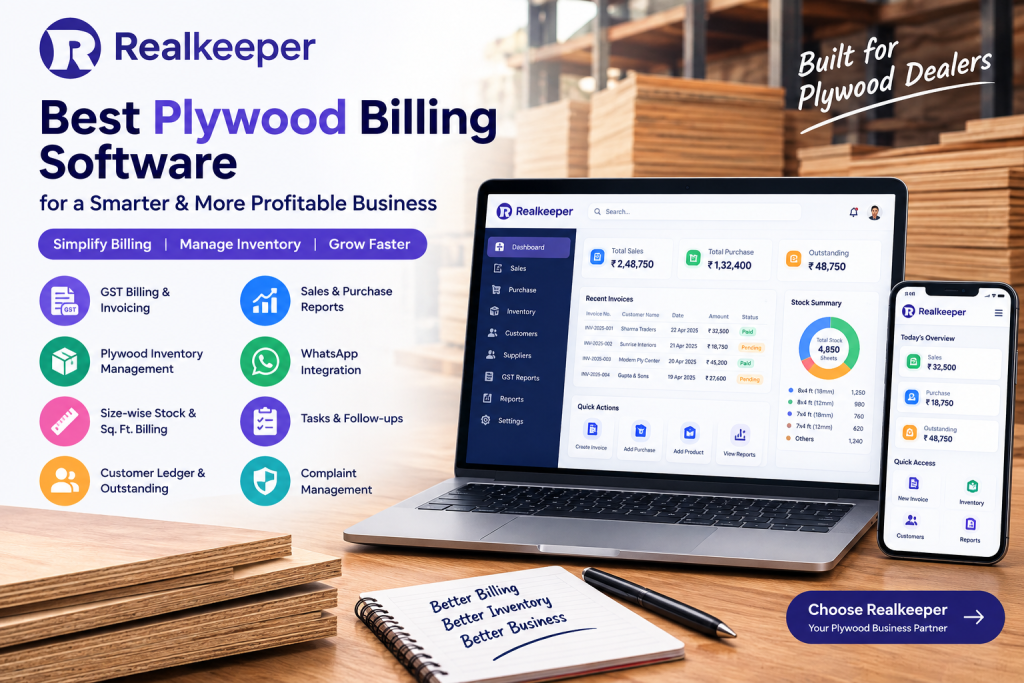
For plywood dealers, relevant RealKeeper capabilities include:
- Accounting
- GST billing
- Sales and purchases
- Plywood inventory management
- Size-wise stock
- Sq. ft. billing
- Customer ledger
- Payment and outstanding tracking
- CRM
- WhatsApp integration
- Tasks and follow-ups
- Complaint management
The combination of these features can help a plywood business manage financial and operational activities more systematically.
RealKeeper vs Other Accounting Software
When evaluating the best accounting software for a plywood business, comparing features is important.
| Feature | Basic Accounting Software | RealKeeper |
|---|---|---|
| Accounting | ✓ | ✓ |
| GST Billing | ✓ | ✓ |
| Sales & Purchases | ✓ | ✓ |
| Customer Ledger | ✓ | ✓ |
| Payment & Outstanding | ✓ | ✓ |
| Inventory Management | Limited/Varies | ✓ |
| Plywood Stock Management | Limited/Varies | ✓ |
| Size-Wise Stock | Limited/Varies | ✓ |
| Sq. Ft. Billing | Limited/Varies | ✓ |
| CRM | Limited/Varies | ✓ |
| WhatsApp Integration | Limited/Varies | ✓ |
| Tasks & Follow-Ups | Limited/Varies | ✓ |
| Complaint Management | Limited/Varies | ✓ |
This comparison highlights an important point: the best accounting software for a plywood business should match the complete workflow of the business rather than only providing basic bookkeeping.
How RealKeeper Can Help a Plywood Business
Plywood Inventory Management
Managing plywood stock requires attention to sizes, quantities, brands, and other product details.
RealKeeper’s inventory capabilities can help businesses maintain more organized stock records.
For dealers looking for the best accounting software for a plywood business, inventory functionality should be one of the first things to evaluate.
GST Billing
GST billing is essential for many plywood dealers. RealKeeper can help businesses create GST invoices and maintain sales transaction records.
This can make the billing process more organized and reduce dependence on manual calculations.
Sq. Ft. Billing
Plywood products are often sold according to dimensions and square feet.
A billing system supporting this type of workflow can make calculations and invoicing more convenient for dealers.
This makes square-feet billing an important feature to consider when choosing the best accounting software for a plywood business.
Customer Ledger
RealKeeper can help businesses maintain customer transaction records and review sales and payment information.
A digital customer ledger can make it easier to understand customer balances and transaction history.
Payment and Outstanding Tracking
Keeping track of pending payments is important for maintaining business cash flow.
RealKeeper can help businesses organize outstanding information and manage payment follow-ups more systematically.
CRM and WhatsApp Integration
Accounting is only one part of a successful plywood business.
Dealers also need to maintain relationships with contractors, builders, retailers, interior designers, and other customers.
CRM functionality can help organize customer information and communication.
WhatsApp integration can also make customer communication and follow-ups more convenient, depending on the workflow.
Tasks and Follow-Ups
Sales teams often need to remember customer calls, payment reminders, quotation follow-ups, and other activities.
Task and follow-up features can help organize these activities and reduce the chances of missing important customer interactions.
Complaint Management
Customer complaints should be recorded and handled properly.
A complaint management system can help businesses track customer issues and improve the process of resolving them.
What Should You Look for in the Best Accounting Software for a Plywood Business?
Selecting software should not be based only on price. Plywood dealers should evaluate whether the software actually fits their business requirements.
1. Plywood-Specific Billing
Check whether the software supports the way your business sells plywood, including product sizes, quantities, dimensions, and square-feet calculations.
2. Inventory Management
Make sure the software can handle your product range and provide sufficient stock visibility.
3. GST Billing
The system should support GST billing and make invoice creation convenient.
4. Customer and Supplier Accounts
Customer ledgers, supplier records, payment tracking, and outstanding management are important for a plywood dealer.
5. Business Reports
Look for sales, purchase, inventory, expense, customer, and payment reports.
6. CRM and Follow-Ups
If your business depends heavily on repeat customers and sales relationships, CRM and follow-up capabilities can provide additional value.
7. Ease of Use
The best accounting software for a plywood business should be easy for business owners and employees to understand and use.
A complicated system may have many features but still fail to improve productivity if employees struggle to operate it.
Manual Management vs the Best Accounting Software for a Plywood Business
Many small plywood businesses still use notebooks, calculators, and Excel spreadsheets.
These methods may work when the business has limited transactions. But as sales, customers, and inventory increase, manual management becomes increasingly difficult.
| Activity | Manual Management | Accounting Software |
|---|---|---|
| GST Billing | Manual calculation | Digital billing |
| Stock Tracking | Register/Excel | Centralized records |
| Customer Ledger | Notebook | Digital ledger |
| Outstanding | Manual checking | Organized tracking |
| Sales Reports | Manual preparation | System-generated |
| Purchase Records | Manual entry | Digital records |
| Sq. Ft. Calculation | Calculator | Supported workflow |
| Customer Follow-Up | Memory/Notes | CRM/Tasks |
Moving toward the best accounting software for a plywood business can help reduce repetitive work and make important information easier to access.
How Accounting Software Supports Plywood Business Growth
Business growth creates more transactions, more customers, more products, and often more employees.
Without proper systems, this growth can create additional administrative work.
The best accounting software for a plywood business can help businesses create organized processes before these challenges become difficult to manage.
For example:
Better inventory visibility can help reduce stock-related confusion.
Faster billing can improve customer service.
Organized ledgers can simplify payment tracking.
Business reports can help owners understand sales and purchasing patterns.
CRM and follow-up features can support better customer relationships.
Therefore, the value of the best accounting software for a plywood business is not limited to accounting. It can support multiple areas of daily business management.
Common Mistakes to Avoid When Choosing Accounting Software
Choosing software only because it is inexpensive can sometimes create problems in the future.
Here are some mistakes plywood dealers should avoid.
Choosing Software Only for Basic Accounting
Basic bookkeeping may not be sufficient if your business requires inventory, GST billing, CRM, or plywood-specific billing.
Ignoring Inventory Requirements
Plywood businesses manage many products and dimensions, so inventory functionality should be evaluated carefully.
Not Checking Billing Features
Always check whether the software supports the actual billing method used by your business.
Ignoring Ease of Use
Employees should be able to learn the system without excessive training.
Not Considering Future Growth
The software should ideally be capable of supporting your business as customers, transactions, employees, and locations increase.
Frequently Asked Questions
What is the best accounting software for a plywood business?
The best accounting software for a plywood business depends on the dealer’s specific requirements. A suitable solution should ideally provide accounting, GST billing, inventory, customer ledgers, outstanding management, reports, and plywood-specific billing capabilities.
Why do plywood dealers need accounting software?
Plywood dealers manage accounting, GST, purchases, sales, inventory, customer credit, payments, and outstanding amounts. The best accounting software for a plywood business can bring these activities together and reduce manual work.
What is plywood accounting software?
Plywood accounting software is a digital solution used to manage accounting and business activities for plywood dealers. Depending on the software, it may include billing, inventory, GST, customer ledgers, purchases, sales, and payment management.
What is plywood billing software?
Plywood billing software helps dealers create invoices and manage sales transactions. The best accounting software for a plywood business may also provide features such as size-wise stock and square-feet-based billing.
Can plywood software manage inventory?
Yes. Inventory-enabled accounting software can help businesses record purchases, sales, and available stock. For plywood dealers, size-wise and product-wise inventory management can be particularly useful.
Is sq. ft. billing useful for plywood dealers?
Yes. If a business sells plywood according to dimensions or square feet, sq. ft. billing can simplify calculations and make invoice preparation more efficient.
Can RealKeeper manage accounting and CRM?
RealKeeper combines accounting and business management capabilities with CRM, customer communication, tasks, follow-ups, and complaint management features.
What features should I check before buying accounting software?
Before choosing the best accounting software for a plywood business, check accounting, GST billing, inventory, size-wise stock, sq. ft. billing, customer ledger, outstanding management, reports, CRM, ease of use, and scalability.
Final Thoughts
A plywood business requires efficient management of accounting, GST billing, inventory, purchases, sales, customer credit, outstanding payments, and customer relationships.
The best accounting software for a plywood business can bring these activities together in one organized system and reduce dependence on notebooks, calculators, and disconnected Excel files.
Features such as plywood inventory management, GST billing, customer ledgers, sq. ft. billing, outstanding tracking, CRM, WhatsApp communication, tasks, and complaint management can create a more efficient workflow.
For plywood dealers evaluating accounting solutions, RealKeeper offers a combination of accounting, billing, inventory, CRM, and business management capabilities.
Ultimately, the best accounting software for a plywood business is the solution that matches your actual workflow, is easy for your employees to use, provides the features your business needs, and can support you as your business grows.
If you are looking for the best accounting software for a plywood business, consider a solution that can manage not only accounting but also billing, inventory, customers, payments, and daily business operations from one platform.
Explore RealKeeper and simplify accounting, GST billing, plywood inventory, customer management, outstanding tracking, and everyday business operations.